
The wolf spider is, by a wide margin, the spider most likely to startle a Davis County homeowner. It is also one of the most useful predators working in your yard. Both of those things are true, and understanding the second one makes the first a lot easier to deal with.
Wolf spiders are large, fast, and hairy, which is the wrong combination if you are trying to avoid alarming people. Davis County has several species, and the big ones can span close to three inches across when you include the legs. But medically they belong nowhere near the only spider you actually need to worry about in Utah, which is the western black widow. Wolf spiders are a nuisance that happens to be doing useful work, and most encounters with them require no action at all.
How to Identify a Wolf Spider
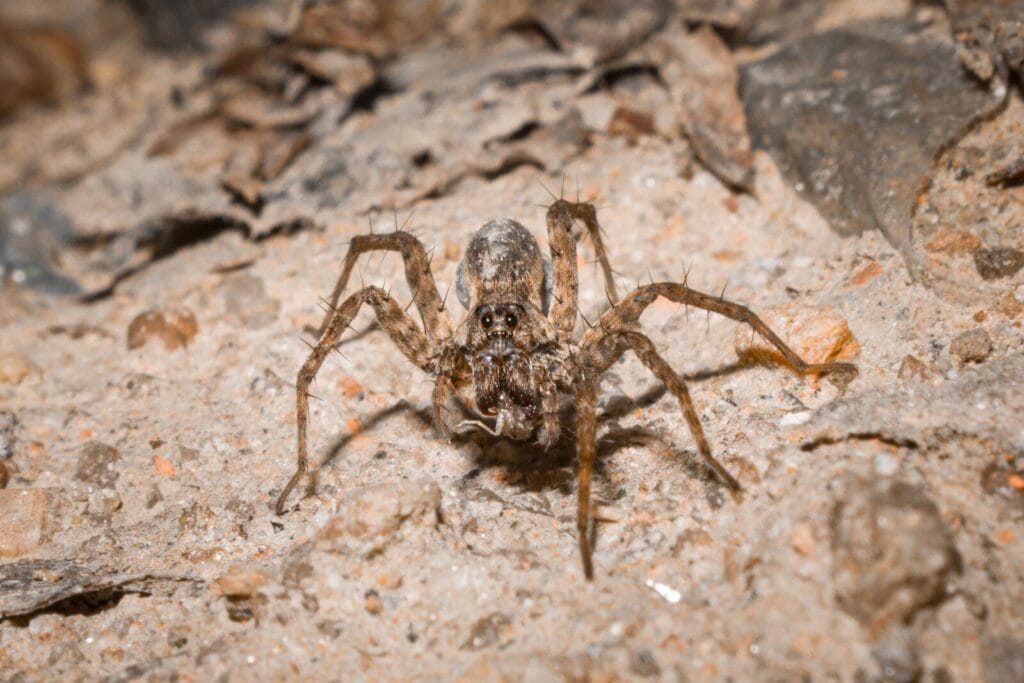
Wolf spiders belong to the family Lycosidae, and they have several reliable identification features. The body is stocky and covered in fine hairs. Color runs from brown to gray to tan, usually with a streaked or mottled pattern and often dark stripes down the cephalothorax. Females run from about half an inch to an inch and a half in body length. Males are smaller. With legs included, a large female can span close to three inches.
The eye arrangement is the clearest identification feature. Wolf spiders have eight eyes in three rows: four small eyes across the bottom, two large eyes in the middle, two medium eyes on top. Those two large middle eyes are the giveaway. Catch one in a flashlight beam at night and the eyes shine back at you with a distinct glow. No other common Utah spider produces that eyeshine as clearly. If you see eyes reflecting light from ground level in a dark garage or window well, you are almost certainly looking at a wolf spider.
They build no webs. This is the most important behavioral clue. A spider sitting in a funnel web or sheet web is a funnel weaver or a grass spider, not a wolf spider. Wolf spiders hunt on foot, running prey down and pouncing on it. If you see a web, keep looking.
The female carrying young is unmistakable. She tows her round egg sac attached to the spinnerets at the rear of her abdomen. After the eggs hatch, the spiderlings climb onto her back and ride there until they can fend for themselves. If you ever see what looks like a spider with dozens of tiny spiders on it, that is a wolf spider mother. She is still not dangerous.
For a full rundown of every spider you are likely to encounter in a Davis County home, including the hobo, the black widow, and the explanation for why brown recluse is not a Utah spider, our common Utah spiders field guide covers each species and what to do about them. The most common confusion point is wolf spider versus hobo spider. Short version: hobo spiders are smaller, brown with no leg banding, and they build a horizontal funnel web. The wolf spider builds nothing. If the spider is sitting in a web, it is not a wolf spider. Our hobo spider post goes deeper if you are trying to sort them out.
Why Wolf Spiders Keep Showing Up
Wolf spiders are outdoor ground hunters. Through spring, summer, and fall they forage in lawns, gardens, woodpiles, and around foundations, eating crickets, beetles, earwigs, ants, caterpillars, and other ground-dwelling insects. In your yard they are self-directed pest control operating at ground level every night. They damage nothing, build nothing, and live entirely at the expense of insects you did not want there.
The late-summer and fall wander is what brings them indoors. As temperatures drop in August through October, wolf spiders move toward warmer areas and follow the prey insects that have already found gaps into garages, basements, and window wells. They enter through door gaps, foundation cracks, and unsealed utility penetrations. Once inside they stay near floor level along walls and in corners. Wolf spiders are poor climbers. The one in your bathtub got there by falling in, not by coming up the drain.
Their speed is what sets people off. Wolf spiders move fast in a straight line without pausing, which reads as purposeful and aggressive. It is neither. Their instinct when they detect a person is to run the other way.
On bites: wolf spiders can bite if handled roughly or trapped against skin, but bites are uncommon and not medically significant. Expect localized pain and redness similar to a bee sting. There is no necrotic wound, no whole-body reaction. Clean the bite and watch it. If you are allergic, reactions may be stronger, and a doctor visit is worthwhile. For most people it resolves in a day or two.
One Wolf Spider Is Normal. Here Is When to Act.
Seeing a wolf spider once or twice through the fall is a normal Davis County experience. Turning one up while moving boxes in the garage, stacking firewood, or doing yard work is exactly where they live. Wolf spiders are solitary hunters and do not breed in colonies indoors. A single wolf spider in the basement does not mean there is a nest somewhere.
A situation that warrants attention looks different. Finding wolf spiders in the living areas of your home regularly, week after week, across multiple locations, is a signal that a healthy insect population around your foundation is drawing them in and that entry points are easy to get through.
The steps that make the most difference are sealing the entry points and reducing what draws insects in. Install tight door sweeps and caulk gaps around utility penetrations and pipe entries. Switch the exterior lights near doors and garage entrances to warm amber bulbs, which attract far fewer insects than white LEDs, and fewer insects means fewer spiders following them inside. Clear leaf piles, woodpiles, and debris away from the foundation, and leave a gap between groundcover, mulch, and the wall.
Inside, vacuum along baseboards to remove spiders and egg sacs, and set glue boards along the wall to monitor and catch wanderers. If you catch one and it is in the garage or window well, capture and release outdoors rather than killing it. Pressing down on a female carrying spiderlings can scatter dozens into the wall gaps. And outside, she was working for you.
Spider phobia is a legitimate reason to treat even when the numbers are low. Not wanting large, fast hunting spiders in your home is a reasonable position entirely on its own.
What Professional Treatment Actually Does
Spiders respond to surface treatments differently than most homeowners expect. A spider walks on its leg tips, body elevated above the ground, while an ant or beetle drags its abdomen across a treated surface and picks up product along its full length. That is why a perimeter barrier works as much by eliminating the prey insects around your foundation as it does through direct spider contact. Remove the food source and the spiders lose the reason they were there.
A professional application also confirms the species. Not every large, fast, ground-level brown spider is a wolf spider, and knowing what you are dealing with before treating makes the treatment more accurate.
Our spider treatment is a foundation and perimeter application targeting both spiders and the prey insects that draw them in. For homes that see consistent spider pressure across the season, our Exterior Spider Barrier Program runs four timed applications from early spring through late fall, with a residual that carries between visits. It is built around the seasonal biology of our local spider populations, treating before each wave of activity rather than chasing spiders once they are already inside.
Are wolf spiders dangerous or venomous?
No. Medically they belong nowhere near the western black widow, the only spider in Utah that is actually a concern. Wolf spiders are a nuisance that happens to be doing useful pest control work in your yard.
Will a wolf spider bite me or my pets?
Bites are uncommon and happen mainly if the spider is handled roughly or trapped against skin. Expect localized pain and redness similar to a bee sting, resolving in a day or two for most people.
How do I tell a wolf spider from a hobo spider?
Wolf spiders build no web at all and hunt on foot. Hobo spiders are smaller, brown with no leg banding, and build a horizontal funnel web. If the spider is sitting in a web, it is not a wolf spider.
Should I kill a wolf spider or let it go?
Capture and release outdoors is the better move. Wolf spiders eat crickets, beetles, earwigs, ants, and other pest insects, so outside, it was working for you. Pressing down on a female carrying spiderlings can also scatter dozens of young into wall gaps.