
Of the dozens of spider species that live in Davis County, exactly one is medically significant. It is the western black widow. It is not the hobo spider, which has spent thirty years with a reputation it does not deserve. It is not the brown recluse, which does not live in Utah at all. And it is not the large, hairy wolf spider that just sprinted across your basement floor, no matter how fast your heart is beating right now.
Most of the spiders Utah homeowners encounter indoors are nuisance pests. They are alarming, they are unwelcome, and a few of them can deliver a mild bite if you press them against your skin. But they are not dangerous. Knowing which ones you are looking at changes how you respond, and it keeps you from spending money on a problem that does not exist while ignoring the one that does.
This is the field guide. Here are the spiders you will actually find in a Davis County home, what each one looks like, and which ones matter.
The One That Matters: Western Black Widow
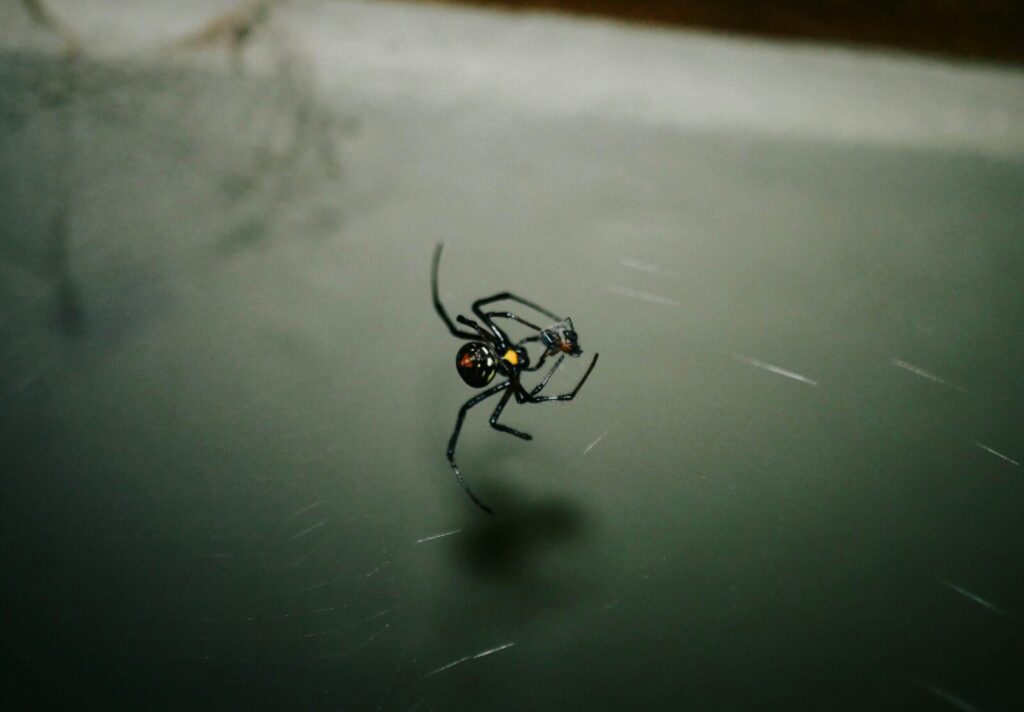
The western black widow is the only spider in Davis County that warrants genuine caution. The mature female is about half an inch in body length, jet glossy black, with a bright red hourglass marking on the underside of the abdomen. Males are smaller, tan or brown, and harmless. The hourglass is the identifier. Nothing else in Utah looks like it.
Black widows build messy, three-dimensional cobwebs in dark, undisturbed spaces close to the ground. In Davis County homes, that means garages, window wells, crawl spaces, irrigation boxes, firewood stacks, and the gap behind garbage cans against the house. They are sedentary spiders. The female almost never leaves her web. Bites happen when someone reaches into a dark space without looking, lifting a flowerpot, grabbing a pair of stored work gloves, or moving stacked firewood with bare hands.
A black widow bite produces severe localized pain, muscle cramping, sweating, and sometimes abdominal rigidity. If you are bitten, seek medical attention. This is the one spider in Davis County where that advice is not an overreaction.
That said, black widows almost never show up in finished living spaces. They live on the perimeter, in garages and outbuildings, in outdoor clutter. If you find one, note the location, do not touch it, and either remove it or have the area treated.
The One Everyone Worries About: Hobo Spider
The hobo spider gets blamed for nearly every spider encounter in a Davis County home. It is common, it is fast, and it has a fearsome reputation that modern science no longer supports.
The CDC removed hobo spiders from its list of venomous species in 2017. No significant scientific evidence supports the claim that their bite causes necrotic skin lesions. The “aggressive house spider” nickname comes from a misreading of the Latin species name “agrestis,” which means “of the field.” The spider is not aggressive. It would rather run than bite.
Hobo spiders are brown with a faint herringbone pattern on the abdomen, roughly a third to half an inch in body length, with a leg span of one to two inches. The key field mark is the legs: uniform brown with no dark bands or stripes. They build flat funnel webs at ground level in basements, window wells, garage corners, and foundation cracks. They cannot climb smooth vertical surfaces, which is why homeowners find them trapped in bathtubs and sinks.
The peak invasion runs August through October when males leave their webs to search for mates. That wandering is what brings them inside through foundation cracks and door gaps.
If you want the full story on hobo spider biology, the necrotic bite myth, identification tips, and prevention, we have a dedicated deep-dive post publishing in March. The short version for this field guide: hobo spiders are a nuisance. Treat them as such.
The Lookalike: Grass Spider
The grass spider is the species most often mistaken for a hobo spider in Davis County, and the confusion is understandable. Both are brown funnel-web builders in the same family. Both are roughly the same size. Both show up around the same time of year.
The difference is in the legs. Grass spiders have distinct dark bands or stripes on their legs. Hobo spiders do not. If the spider in your bathtub has clear leg banding, it is almost certainly a grass spider. Grass spiders also have two prominent spinnerets projecting from the rear of the abdomen that are visible from above.
Grass spiders are completely harmless. They build their funnel webs in lawn thatch, garden beds, and low shrubs. Males wander indoors occasionally in fall. They are the most common funnel-web spider in Utah yards by a wide margin.
The Harmless Roommate: Domestic House Spider
The domestic house spider is the hobo spider’s smaller, gentler cousin and one of the most common indoor spiders in Davis County. It builds a small funnel web in undisturbed basement corners, closets, and behind furniture. Body length runs about a quarter to half an inch.
The tell that separates it from a hobo: the domestic house spider has distinct dark banding on its legs, similar to a grass spider. Hobo spiders have solid unbanded legs. If you see a small funnel-web spider in your basement with striped legs, this is almost certainly what you have.
Domestic house spiders reproduce indoors and can persist year-round. They are completely harmless and rarely noticed unless you are looking for them.
The One That Scares Everyone: Wolf Spider
Wolf spiders are the big, fast, hairy spiders that sprint across the basement floor at night and make people consider selling the house. They are ground hunters that do not build webs. Several species live in Davis County, ranging from half an inch to over an inch in body length with stocky, hairy legs.
The easiest identification feature: wolf spiders have two large prominent eyes on the top of their head that reflect light. If you shine a flashlight at the floor at night and see two bright green dots staring back, that is a wolf spider.
Females carry their egg sac attached to the rear of the abdomen and, once spiderlings hatch, carry the babies on their back. This is unique among Utah spiders and sometimes produces the alarming sight of what appears to be a spider covered in dozens of tiny spiders. That is exactly what it is, and it is still not dangerous.
Wolf spiders can bite if physically pressed against skin. The result is similar to a bee sting: localized redness and mild pain that resolves in a day or two. They are not medically significant. They enter homes in fall seeking warmth and prey, and the fix is the same as for any ground-level invader: door sweeps and foundation sealing.
The Creepy-Looking One: Woodlouse Spider
The woodlouse spider is one of the most distinctive spiders you can find in a Davis County basement. It has a glossy dark red to orange front half, a smooth pale beige abdomen, and disproportionately large forward-projecting fangs that look like they belong on a much bigger animal. Body length is about a third to half an inch.
As the name suggests, woodlouse spiders eat pill bugs, sowbugs, and roly-polies. They live wherever their prey lives: damp basements, crawl spaces, under stones, and near foundation moisture. They are nocturnal hunters that do not build webs.
Those large fangs can deliver a painful pinch if you handle one, but there is no venom concern. The pain is mechanical, not chemical. Leave them alone and they will keep eating the pill bugs in your basement, which is a service you did not ask for but are getting for free.
The Basement Tenant: Cellar Spider
The cellar spider, also called the daddy longlegs spider, is the thin-legged spider in the corner of every basement and garage in Davis County. Tiny pale body, about a quarter inch long, with legs five to six times the body length. It builds loose, messy cobwebs on ceilings and in upper corners.
The claim that cellar spiders are “the most venomous spider in the world but their fangs are too small to bite” is an internet myth. They are completely harmless to humans.
Here is the useful part: cellar spiders are predators of other spiders. They will catch and eat hobo spiders, domestic house spiders, and even juvenile black widows that wander into their webs. Killing cellar spiders is genuinely counterproductive if you have hobo spider pressure. Consider leaving them alone. If the cobwebs bother you, a broom handles it.
The Nighttime Walker: Yellow Sac Spider
Yellow sac spiders are small, pale yellow to beige, about a quarter to a third of an inch in body length. They do not build a hunting web. Instead, they construct a small silk sleeping sac where walls meet ceilings or behind picture frames during the day and come out at night to hunt across walls and ceilings. Look for darker coloring at the tips of the legs, sometimes called “dark socks.”
Yellow sac spiders bite more readily than most other indoor spiders in Utah, usually when trapped against skin in clothing, bedsheets, or shoes left on the floor. The bite is painful with localized burning and redness that resolves in a day or two. It is not medically significant despite older claims.
If you keep finding small silk sacs in upper wall corners, yellow sac spiders are the likely resident. Vacuum the sacs, shake out clothing and shoes stored on the floor, and address the perimeter.
The One That Is Not Here: Brown Recluse
This entry exists because “brown recluse in Utah” is one of the most common spider searches in the state, and the answer needs to be clear: brown recluse spiders are not established in Utah. Their natural range is the south-central United States, centered on Missouri, Kansas, Oklahoma, and surrounding states. The closely related desert recluse reaches the extreme southwestern corner of Utah in Washington County desert habitat, hundreds of miles from Davis County.
Every “brown recluse in my Bountiful basement” or “brown recluse bite in Layton” is a misidentification. The spider is almost always a hobo spider, a domestic house spider, a wolf spider, or a crevice weaver. And the “brown recluse bite” is almost always a bacterial skin infection that looks similar but has nothing to do with a spider.
If you genuinely believe you have found a brown recluse, capture it in a glass with a piece of cardboard and have it identified. The Davis County USU Extension office or our technicians can help. The odds that it is actually a brown recluse in Davis County are essentially zero.
Why Spiders Come Inside
Spiders do not come inside because they like your house. They come inside because they found a gap in your weather seal while doing something else.
The biggest driver is mating season. Male hobo spiders, grass spiders, and wolf spiders wander in August through October looking for females. That wandering takes them through foundation cracks, under loose door sweeps, and into basements and garages. This is why spider sightings spike every fall.
The second driver is prey. Spiders follow insects. Insects follow lights. Bright white exterior lighting near doors and garage openings attracts moths and beetles, which attract the spiders that eat them. Switching to yellow or sodium vapor bulbs near entry points reduces the prey magnet.
The third is habitat near the foundation. Woodpiles, rock walls, dense ground-cover plants, and stored equipment against the house give spiders cover within stepping distance of your walls. A clean band of open ground around the foundation makes the trip from yard to basement longer and less protected.
When to Call for Help and When to Leave Them Alone
Most spiders in a Davis County home do not need professional treatment. A cellar spider in the basement corner is doing you a favor. A wolf spider that wandered in through the garage is a one-time visitor that a cup and a piece of cardboard can handle. A grass spider that fell into the bathtub is harmless and lost.
The situations that warrant a call are specific.
Black widow sightings anywhere on the property. Black widows are the real medical concern in Davis County, and if you are seeing them in your garage, window wells, or foundation perimeter, a targeted treatment and harborage cleanup is the right response.
Repeated hobo spider or funnel-web spider encounters indoors, more than a few per week during fall. That volume means entry points are open and the population near your foundation is established. Door sweeps and foundation sealing combined with a residual barrier treatment on the perimeter is what breaks the cycle.
Yellow sac spider infestations with multiple silk sacs in living spaces. These spiders breed indoors and persist year-round, so consistent treatment matters more than a single spray.
Any situation where you are not sure what you are looking at and the spider is in a location where people could be bitten, especially near beds, in shoes, or in work gloves stored in the garage.
We have been treating spider pressure on Davis County homes for over four decades, from Bountiful to Layton to Kaysville and every city in between. Our spider treatment is a residual barrier applied to the foundation, window wells, and garage perimeter, timed to the season when spider pressure is highest. Our full pest control services page covers everything we offer beyond spiders, including wasp and hornet removal, ant control, and box elder bug treatment.
The bottom line is simple. One spider in Davis County is medically significant: the black widow. Everything else is a nuisance. Know the difference, respond accordingly, and do not let the internet convince you that your basement is more dangerous than it actually is.