
Most lawn care advice on the internet was written for soil nothing like what sits under Davis County lawns. The guides assume midwestern loam or East Coast clay loam with regular summer rainfall and a pH around 6.5. Davis County is different in ways that change how water moves, how nutrients behave, and how deep roots can grow. If you have ever felt like you are doing everything right and the lawn still looks wrong, the soil is almost always the reason.
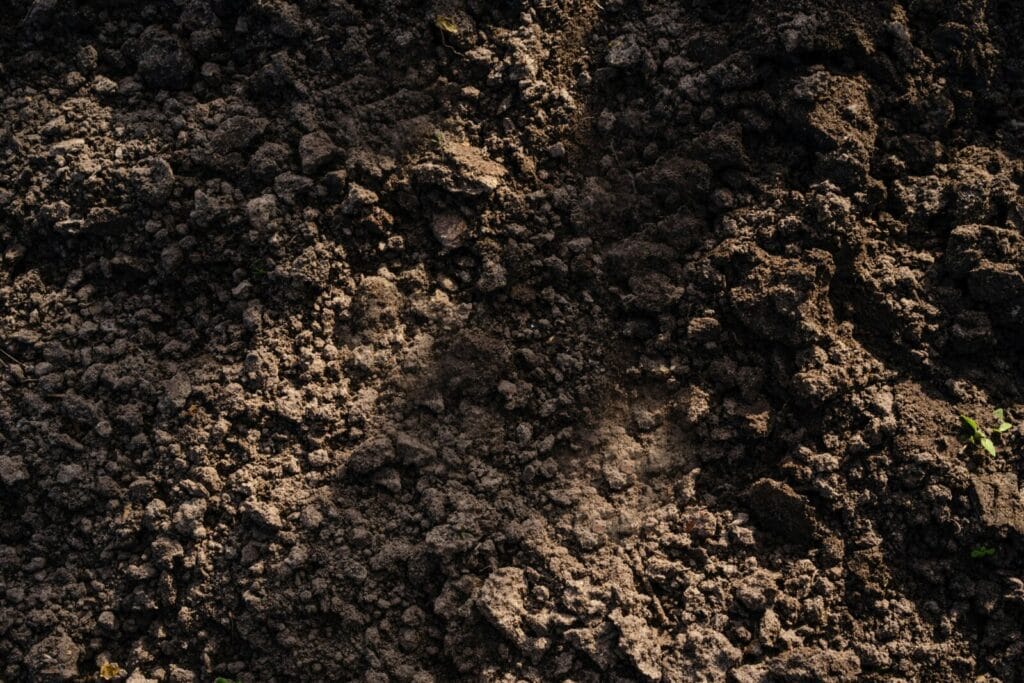
The clay along the Wasatch Front came from Lake Bonneville, the massive Ice Age lake that covered this valley roughly 15,000 years ago. The fine particles that settled out of that water are what we grow grass on today. They compact tightly, drain slowly, run alkaline, and hold calcium carbonate in layers that can stop roots cold. Understanding what that means for your specific lawn is the first step toward fixing the problems it creates.
What Davis County Clay Does to a Lawn
Three characteristics of our soil cause most of the lawn problems homeowners see along the Wasatch Front.
The first is slow drainage. USU Extension puts the infiltration rate of Utah clay at 0.01 to 0.5 inches per hour. A typical residential spray-head sprinkler delivers 1.3 to 2.0 inches per hour. That mismatch means most of the water a homeowner applies never reaches the root zone. It pools on the surface, runs off onto the sidewalk, or collects in low spots where it sits and suffocates roots. The lawn looks dry even though the sprinkler ran.
The second is high pH. Utah soils along the Wasatch Front commonly run pH 7.5 to 8.5. Kentucky bluegrass prefers 6.0 to 7.0. At pH 8.0 and above, iron in the soil gets locked into chemical forms the plant cannot absorb. The iron is physically present, but the grass cannot use it. The result is iron chlorosis: yellow-green grass with darker green veins, especially on new growth. Homeowners see yellow and add nitrogen fertilizer, which makes the problem worse because it pushes growth on a plant that cannot produce enough chlorophyll. The actual fix is chelated iron in a formulation that stays available at high pH.
The third is compaction. Clay particles are flat and small. They pack tightly under any pressure, including foot traffic, mower wheels, irrigation impact, and freeze-thaw cycles. Compacted clay restricts root growth, blocks oxygen exchange, and holds moisture at the surface where it feeds fungal diseases instead of grass roots. Necrotic ring spot, the most damaging Kentucky bluegrass disease in our region, thrives in exactly these conditions: wet, compacted, poorly drained soil around shallow root systems.
On newer construction lots built since the mid-1990s, the problem is worse. Builders scrape the original topsoil, compact the subgrade to support the foundation, and roll sod over a thin layer of imported fill. The grass is rooted in a few inches of okay soil sitting on top of compressed clay that functions like a brick.
How to Tell If Clay Is Behind Your Lawn Problems
Run your sprinklers for ten minutes on a flat section of lawn. If water pools on the surface or streams toward the curb before the zone finishes, your soil cannot keep up with the application rate. That is the most common Davis County symptom and the easiest to spot.
Push a screwdriver into the lawn an hour after watering. It should slide six inches into the soil with moderate hand pressure. If it stops at two or three inches, compaction or a dry layer below the wetted surface is the reason.
Cut a small square of turf with a spade and check the roots. Healthy Kentucky bluegrass on well-prepared soil sends roots three to four inches deep or more. On compacted Davis County clay, roots commonly stop at one to two inches and spread sideways instead of down. Shallow roots mean a lawn that wilts fast in summer, recovers slowly from stress, and thins out in the same spots year after year.
Look at the color pattern. If the grass is yellow-green overall but darker in the veins, and nitrogen fertilizer did not fix it last year, iron chlorosis is the likely cause. If you see brown rings with green centers appearing in late June or July, necrotic ring spot is feeding on roots weakened by compacted, waterlogged clay.
What Homeowners Can Change on Their Own
The most effective changes cost nothing and require no products.
Switch to cycle-and-soak watering. Instead of running a zone for 20 minutes straight, split it into three or four short cycles of five to seven minutes with 30 to 60 minutes between each. This gives the clay time to absorb each round before the next one starts. It is the single biggest improvement most Davis County homeowners can make.
Raise the mowing height to 3 inches or higher. Taller grass shades the soil, reduces surface temperature, and encourages deeper root growth. On clay, every extra fraction of an inch of root depth matters because the window of available moisture is so shallow.
Get a soil test through the USU Analytical Lab before spending money on fertilizer or amendments. Most Davis County lawns come back with phosphorus already high and pH above 7.5. That means a nitrogen-focused fertilizer is usually the right choice, and a high-phosphorus “starter” product is wasted money. The test is about $25 and eliminates guesswork.
Do not add sand to a clay lawn. USU Extension is direct about this: sand mixed in the wrong proportion with clay creates something that sets up like low-grade concrete. The right amendment is compost, worked in during establishment or topdressed in thin layers after core aeration.
For iron chlorosis, look for a chelated iron product labeled EDDHA. Standard iron sulfate and DTPA-chelated iron products lose most of their effectiveness above pH 7.5. EDDHA chelate stays stable up to about pH 9.0, which is why it works on Wasatch Front soils where other iron products disappoint.
How We Build Programs Around Davis County Soil
Most lawn care companies sell individual treatments: a fertilizer round, a spray, an aeration visit. That model works on easy soil. On Davis County clay, single services often underperform because the soil undoes the benefit before the next visit.
Our Full Season Lawn Program is designed around the soil first. Fertilizer selections respect the alkaline chemistry instead of fighting it. We weight applications toward slow-release nitrogen and supplement with chelated iron where chlorosis warrants it, rather than defaulting to a generic high-phosphorus product that the soil does not need.
We schedule core aeration based on compaction severity, not a one-size calendar. Properties on builder-grade lots or heavy-traffic lawns often need two passes in the first year, spring and fall, to start reversing the accumulated damage. Annual aeration after that keeps the channels open for water and roots.
We also talk through irrigation with clients on every program. It does no good to put down fertilizer on a lawn that loses half its water to runoff. Cycle-and-soak setup, zone run times, and seasonal adjustments are part of the conversation because they determine whether the products we apply actually reach the root zone.
The common thread is that clay soil lawn care in Davis County is a soil-structure problem first and a chemistry problem second. Products layered on top of broken soil structure do not compound. They just get more expensive. The services that move the needle are the ones that fix what is happening underground: aeration to open pore space, proper watering to keep it open, and fertilization calibrated to what the soil already has rather than what the bag says to apply.