
If you are thinking about hiring a lawn care company this year, the first question worth answering is what you are actually paying for. Most homeowners assume a professional lawn care program handles everything. It does not. It handles a specific set of treatments on a specific schedule, and it leaves several important jobs to you.
That gap between what you expect and what you get is where most disappointment with lawn service starts. This post is the honest version: what each visit covers, what you still handle yourself, what typically costs extra, and how to tell whether a company is worth your money.
What a Five-Visit Program Covers
A standard professional lawn care program in Davis County runs five visits from March through October. That schedule is built around Kentucky bluegrass, which is what grows in virtually every residential lawn along the Wasatch Front. The visits are spaced roughly five to eight weeks apart, and the timing shifts year to year based on weather and soil temperature rather than fixed calendar dates.
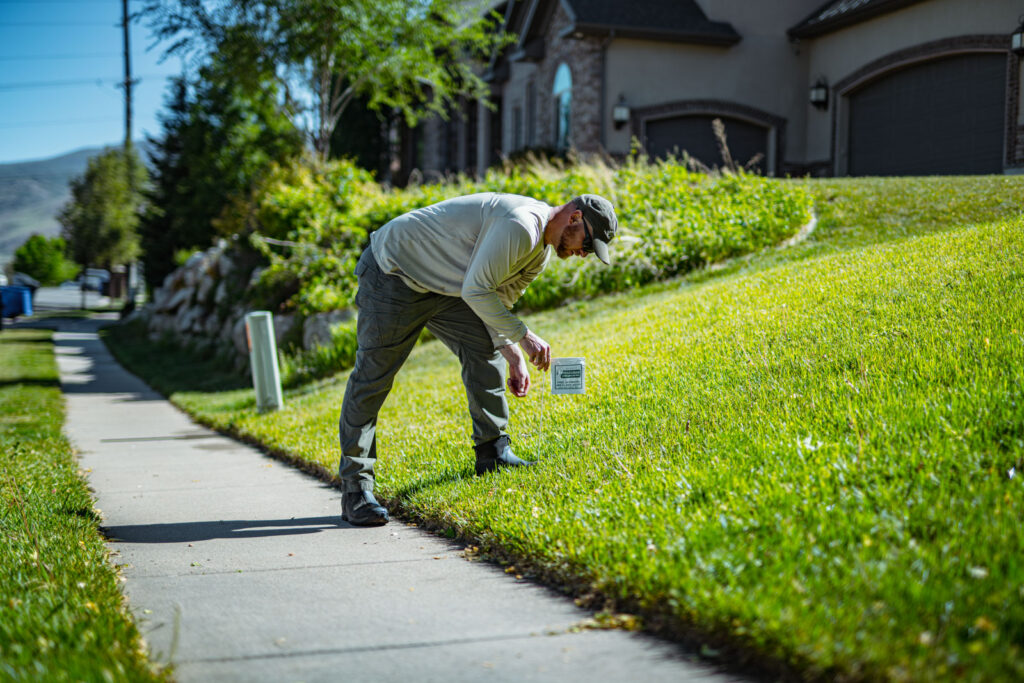
The first visit goes down in early spring, usually sometime between mid-March and mid-April. This is the most time-sensitive treatment of the year. It includes a pre-emergent herbicide that creates a barrier in the top layer of soil to stop crabgrass and other summer annuals from germinating. It also includes the first fertilizer application of the season and broadleaf weed control if early weeds are already showing. The pre-emergent has to be in the ground before soil temperature at the top two inches reaches 55 degrees for several consecutive days. Miss that window and crabgrass germinates right through it.
The second visit follows about five to six weeks later. It targets broadleaf weeds that are now actively growing, things like dandelions, clover, mallow, and bindweed, along with another round of fertilizer. This is when weed pressure peaks in spring, and the products work best when the weeds are growing fast enough to absorb the herbicide and move it into their roots.
The third visit shifts to summer. Liquid fertilizer gets replaced with slow-release granular because liquid nitrogen in high heat can burn Kentucky bluegrass. The granular product feeds roots steadily for several weeks without the flush-and-crash that liquid causes in July. Spot weed treatment continues for anything that made it through the spring rounds.
The fourth visit comes in late summer. This is a maintenance application: broadleaf weed control for late-season weeds, iron to support color without pushing growth during heat stress, and often a soil conditioner or wetting agent to help clay hold moisture between waterings. Everything about this visit is designed to keep the lawn stable through August and into September, not to push it to grow.
The fifth visit is fall, and it is the most important one of the year. A slow-release fertilizer goes down when the grass has stopped growing blades but the roots are still active underground. That feeding builds the carbohydrate reserves the plant stores through winter and draws on the following spring. If a homeowner only paid for one visit all year, this is the one that makes the biggest difference in how the lawn looks the next season.
What You Still Handle Yourself
This is where the misunderstanding usually lives. A lawn care program is a treatment service, not a maintenance contract. The company applies products. You do the rest.
Mowing is yours. Keep the mower at 3 to 3.5 inches all season. That height shades the soil, holds moisture, and helps the grass crowd out weeds on its own. Never cut more than a third of the blade in one pass. Sharpen the blade at least once during the season.
Watering is yours. On Davis County clay, the right approach is cycle and soak: split each zone into two or three short runs with 30 to 60 minutes between them so the water actually soaks into the soil instead of running off into the gutter. Two or three deep waterings per week is better than daily shallow ones. Daily watering builds shallow roots and sets up problems in August.
After treatment, there is usually a window to follow. Pre-emergent needs to be watered in within about two weeks to activate. Granular fertilizer benefits from watering within a few days. Liquid applications dry on their own. Your company should tell you what to do after each visit. If they do not, ask.
Leaf cleanup in fall is yours. Getting leaves off the lawn before the first heavy snow prevents snow mold, which shows up as matted gray or pink patches the following spring.
What Typically Costs Extra
Several services that homeowners assume are included in a lawn care program are actually separate line items.
Core aeration is the most common one. On Davis County clay, annual aeration makes a real difference in root depth, water infiltration, and overall turf health. It is almost always priced separately, either as a standalone service or bundled into a higher-tier program.
Grub control is sometimes included and sometimes an add-on depending on the company and the program level. If your lawn had grub damage last year, ask specifically whether preventative grub treatment is in your program or whether it needs to be added.
Fungicide treatment for diseases like necrotic ring spot or dollar spot is a separate program. These are not routine treatments. They are targeted applications for lawns that have a confirmed disease problem, and they require a different visit schedule and different products than the standard five-visit plan.
Overseeding is not part of a treatment program because pre-emergent herbicide kills grass seed the same way it kills weed seed. If you need to fill in bare spots, plan that for late summer or early fall in areas where pre-emergent was not applied.
Tree and shrub care, pest control for spiders and ants, and wasp removal are all separate services with their own pricing. A lawn treatment company may offer all of these, but they are not bundled into the base lawn program.
How to Decide If It Is Worth It
The honest answer is that a professional lawn care program is worth it when you do not want to track the timing yourself. The products are not secret. Most of what a lawn care company applies is available at garden centers. The value is in knowing when to apply what, adjusting for soil temperature and weather, and using commercial-grade formulations mixed for Davis County’s alkaline clay instead of a generic bag designed for the national market.
A few things to ask any company before signing up. Do they adjust pre-emergent timing to actual soil temperatures, or do they start on the same date every year regardless of the spring? What products are they applying, and will they tell you the active ingredients and rates? Do they use slow-release nitrogen in summer, or are they spraying liquid in July heat? What should you be doing between visits? And what is the cancellation policy?
Walk away from any company that promises a weed-free lawn, guarantees green in 48 hours, refuses to name the products they use, or locks you into a multi-year contract with no way out.
We have been running programs on Davis County lawns from our office in Centerville since 1981. Our Full Season Lawn Program covers the five-visit schedule described in this post with fertilizer blended for Utah’s alkaline soil, and we offer a 7 percent prepay discount if you lock in before the season starts. Our lawn care services page covers the full list of what we offer, including the add-ons mentioned above. If you want a quote for your property, contact us for a free estimate. January and February are the best time to get on the spring schedule before the first visit fills up.