
Lawn care in Utah is not complicated. The timing is just specific. Davis County homeowners who get the sequence right end up with a lawn that mostly takes care of itself. The ones who get it wrong spend money catching up all season.
Two windows matter more than all the others combined. The pre-emergent application in early spring has to land before crabgrass germinates, and the fall fertilizer in September has to go down while roots are still active. Hit those two and everything else is refinement. Miss either one and the rest of the calendar cannot fully compensate.
This is the month-by-month guide. It covers lawn care, tree care, and pest control for Davis County, with the understanding that lower-elevation properties in Bountiful, Centerville, and Farmington typically run one to two weeks ahead of higher spots like Fruit Heights and east Kaysville.
January
The lawn is dormant. Use this month for planning and budgeting. If you have never had your soil tested, order a test through the USU Analytical Lab. Most Davis County results come back with high phosphorus and alkaline pH, which tells you to use nitrogen-focused fertilizer, not a balanced bag from the hardware store. Review what worked last year, note where weeds were heaviest, and decide whether you want to handle the season yourself or hire a program. Getting on a provider’s spring schedule now avoids the March rush.
February
The back half of February is when things start moving on the lower bench. Sharpen or replace the mower blade. Service the mower. Inspect the sprinkler system while it is still dry, and flag any cracked heads or damaged risers for repair before pressurization.
If you have fruit trees, the dormant oil spray window opens this month for early-breaking species like apricots and peaches. The spray goes on at bud swell, not before, when daytime temperatures hold above 40 degrees with no freeze expected for 24 hours. Our fruit tree spraying service covers the timing and application for trees too tall for a backyard pump sprayer.
Watch for snow mold appearing as gray or pink circular patches where snow is receding. Rake those areas gently to break up the mat and let them dry.
March
This is the month that makes or breaks the year. Pre-emergent herbicide needs to be in the ground before soil temperature at two inches reaches 55 degrees for several consecutive days. On the lower bench, that window usually falls in the first two weeks of March. On the upper bench, closer to the third or fourth week.
First mowing happens once the lawn is actively growing, typically mid-month. Set the deck at 2.5 to 3 inches. Do not scalp. Spring cleanup goes hand in hand: rake matted areas, clear any remaining leaf debris, and check for salt damage along sidewalks and driveways. Our pre-emergent service handles the timing so you do not have to track soil temperatures yourself.
Watch for dandelions and other broadleaf weeds pushing through early. First wasp queens are scouting nest sites under eaves this month.
April
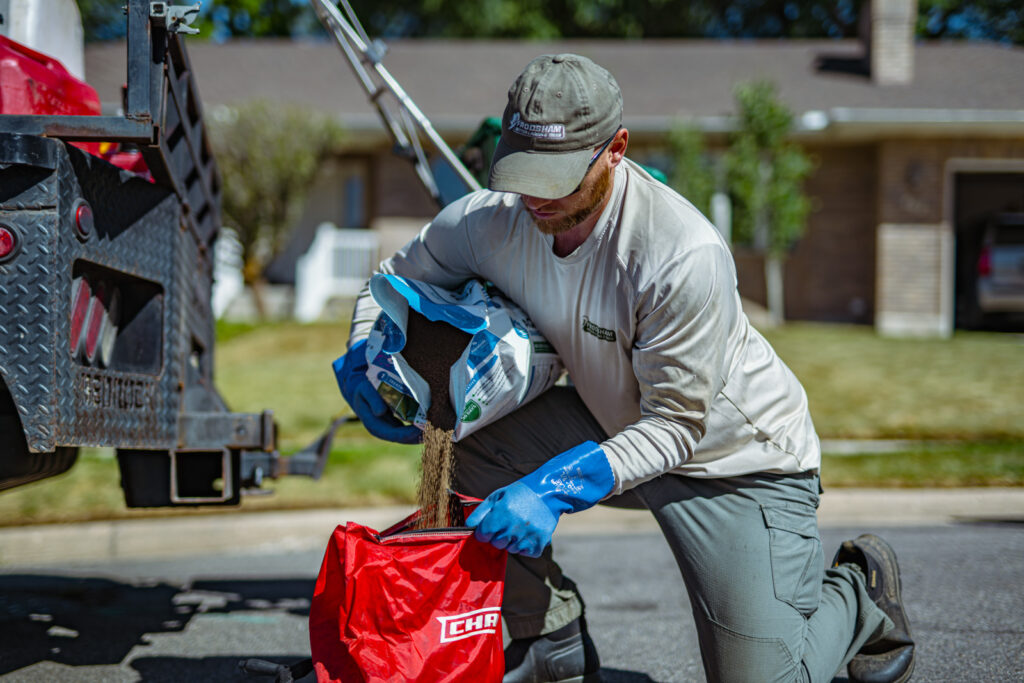
The first full fertilizer application goes down this month, either combined with pre-emergent or as a follow-up visit. Broadleaf weed control targets dandelions, clover, and mallow while they are actively growing and most vulnerable to herbicide.
Spring core aeration can happen this month, but it must go in before pre-emergent. Punching holes through a fresh pre-emergent barrier defeats the purpose. If you missed that window, fall aeration works just as well and is generally more beneficial for cool-season grass.
This is also the right month for spring deep root feeding on trees that struggled last year, especially species prone to iron chlorosis on alkaline soil like silver maple, red maple, and pin oak. Our lawn fertilization service covers the spring feeding, and our deep root fertilizer service handles tree nutrition separately.
Grub prevention timing starts this month. Preventative products work best applied April through May, well before grub damage shows up in July.
May
Second fertilizer round goes down early in the month. Irrigation startup timing varies by city and water provider. Check your secondary water date before turning anything on.
Once water is running, set a cycle-and-soak schedule from the start. On Davis County clay, that means splitting each zone into two or three short runs with 30 to 60 minutes between them so water soaks in instead of running off. Two or three deep waterings per week beats daily shallow watering every time.
Spurge seeds germinate as soil temperatures climb past 60 degrees. If your pre-emergent was applied correctly and on time, it handles spurge. If you see it popping up along hardscape edges, the barrier may have broken down in those spots.
Watch for small paper wasp nests forming under eaves and deck railings. Knock them down early before workers arrive.
June
Summer watering becomes the dominant variable. Raise mowing height to 3 to 3.5 inches and keep it there through September. Taller grass shades soil, holds moisture, and crowds out weeds on its own. Mow with a sharp blade. Dull cuts tear the grass and invite disease.
Ant pressure peaks indoors this month. Grub prevention products applied in April are working underground. Light summer fertilizer is fine if the lawn needs a boost, but do not push nitrogen in heat. Our weed control service handles any broadleaf weeds that made it through the spring rounds.
Watch for yellowing patches that do not respond to watering. That can be early grub damage, billbug feeding, or the start of a fungal problem. Diagnosis matters before treatment.
July
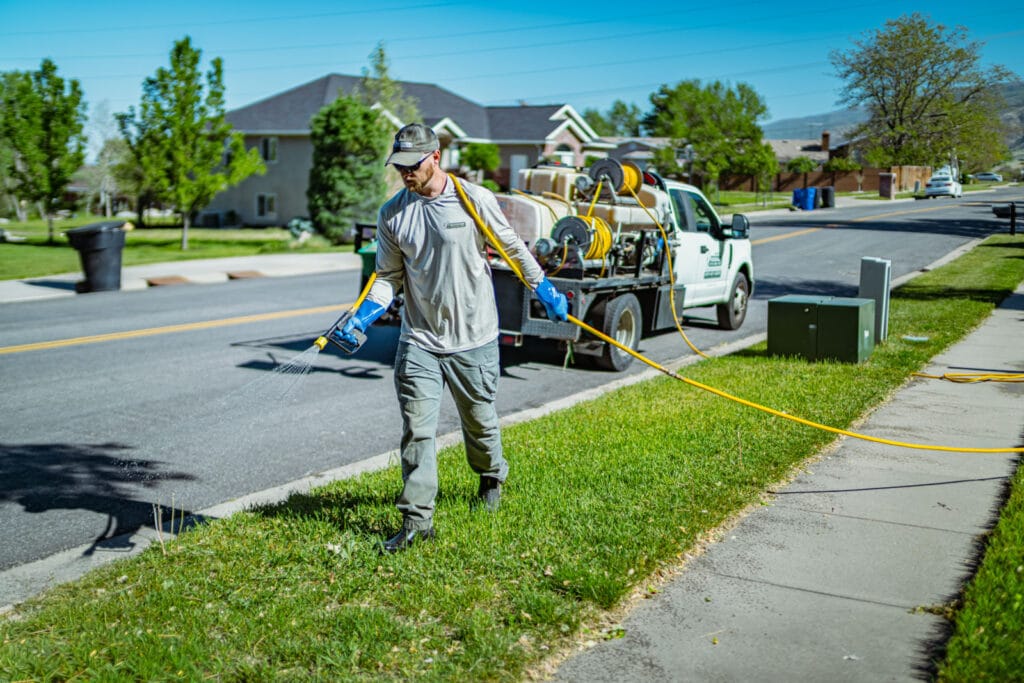
Peak heat. Keep mowing high and water early in the morning only. Cycle and soak is non-negotiable on clay. A single long run will sheet off the surface and pool in the gutter. Three short pulses 30 minutes apart get water into the root zone where the lawn can actually use it.
If you see brown circular patches that expand over a few weeks, especially rings or arcs of dead grass with green centers, that is likely necrotic ring spot or summer patch fungus. Both are serious on Kentucky bluegrass and need targeted treatment, not more water. Our fungus control service handles diagnosis and treatment for Davis County lawns with active disease.
Watch for skunks or raccoons digging in the lawn at night. That is a sign grubs are feeding below the surface.
August
The fall aeration window opens mid-month. Aeration paired with overseeding into thin areas is the single biggest improvement you can make on compacted Davis County clay. This is also when hobo spider mating migration begins. Males leave their funnel webs and start wandering into basements and garages through foundation cracks and door gaps. Our spider treatment times the late-summer barrier to be fresh when the migration starts.
Late-summer fertilizer, light and slow-release, supports recovery from heat stress and sets up the transition into fall.
Watch for yellowjackets aggressively scavenging at outdoor meals and trash cans. Colonies are at peak population this month. If you have ash trees, scout for emerald ash borer symptoms: top-down canopy thinning, D-shaped exit holes in bark, and unusual woodpecker activity. EAB has not been confirmed in Utah but is established in neighboring Colorado.
September
If you only fertilize once a year, do it now. Early to mid-September is the highest-impact feeding for Kentucky bluegrass on the Wasatch Front. The grass has stopped pushing blade growth but the roots are still active underground. That feeding builds the carbohydrate reserves the plant stores through winter and draws on the following spring. Pair it with core aeration for maximum effect. Our core aeration service uses commercial equipment that pulls deeper plugs than rental machines.
Broadleaf weed control is also highly effective this month. Weeds are pulling energy down to their roots for winter, and herbicide travels with it.
This is peak hobo spider month. If you are seeing more than a few spiders per week indoors, entry points are open and a barrier treatment is the right response.
October
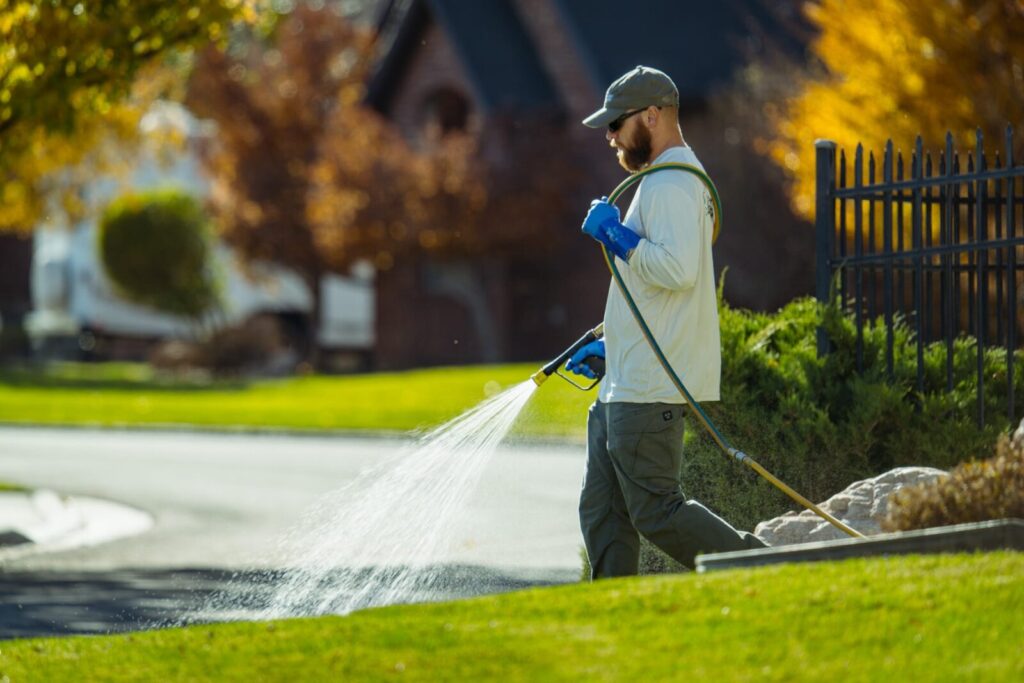
Winterizer fertilizer goes down this month, typically high nitrogen with potassium. This is the last feeding before the ground freezes and it reinforces everything the September application started.
Schedule the sprinkler blowout for the first half of October. The average first freeze on the lower bench runs October 7 to 18. Fruit Heights and the upper bench should not wait past the first week. Blowout companies fill up fast after the first freeze warning.
Fall deep root feeding is the second high-value window for tree nutrition. If your trees showed iron chlorosis or thinning canopy last year, this is when to address it.
Watch for leaves smothering the lawn. Matted leaves over winter are the biggest preventable cause of spring snow mold. Get them off before the first heavy snow.
November
Drop the mower one notch to about 2 to 2.5 inches for the final cut. Shorter grass going into winter reduces matting and snow mold risk. Finish leaf cleanup. If you missed the October winterizer, early November is the last window before the ground freezes.
Spider activity declines as temperatures drop. A late-fall barrier treatment closes out the year. If you had wasp nests under eaves this summer, remove them now while colonies are dead. The nest will not be reused, but removing it prevents confusion next spring.
December
The lawn is dormant. Let it rest. Walk the property a few times during dry spells to check for vole activity under snow, ice around backflow preventers, and broken branches from snow load. This is the month to plan next year. The best providers fill their spring schedules before March, and the pre-emergent window is too narrow to wing.
If you want the full year handled, our Full Season Lawn Program covers all five treatment visits from pre-emergent through winterizer. Contact us for a free estimate and to get on the spring schedule before it fills up.