
The hobo spider has spent three decades being called dangerous, aggressive, and flesh-eating. Almost none of that is true. The CDC removed hobo spiders from its list of venomous species in 2017. No significant scientific evidence supports the claim that their bite causes necrotic skin lesions. And the nickname “aggressive house spider” comes from a misreading of the Latin species name “agrestis,” which actually means “of the field.” The spider is not aggressive. It is fast, it is common, and it would rather run from you than bite you.
But here is what is true: hobo spiders invade Davis County homes every year from August through October, and when a fast brown spider the size of a quarter shows up in your bathtub in September, the biology lesson does not matter much. You want it gone, and you want the next one to stay outside.
What Hobo Spiders Are and Why They End Up in Your House
The hobo spider, Eratigena agrestis, is a funnel-web spider in the family Agelenidae. It is native to Europe and was first detected in the Pacific Northwest in the 1930s. It was identified in Utah around 1990 and is now distributed throughout northern Utah, including all of Davis County.
Hobo spiders build flat, horizontal sheet webs with a funnel-shaped retreat at one end, usually in a corner, crevice, or gap at ground level. They are fast runners that chase prey rather than waiting in elaborate webs. They cannot climb smooth vertical surfaces. That is why homeowners find them trapped in bathtubs, sinks, and window wells. They did not come up the drain. They fell in and cannot climb out.
The mating season is what drives the home invasion. Males mature in late summer and begin wandering in search of females. That wandering takes them through foundation cracks, under door gaps, and into basements and garages. The peak window in Davis County runs from August through October. After mating, males typically die within a few weeks. Females can live up to two years and deposit egg sacs in sheltered outdoor spots in fall. Those eggs hatch the following spring, and the cycle takes roughly two years from egg to mature adult in Utah’s climate.
Most Davis County homes will see at least one hobo spider during the fall. That is normal. A dozen is a sign that entry points need attention.
How to Tell If It Is Actually a Hobo Spider
Honest answer: you probably cannot confirm it without a microscope. Hobo spiders look like several other brown spiders common in Utah, and positive identification requires examining reproductive structures under magnification. But there are a few things to check and a few things that rule it out.
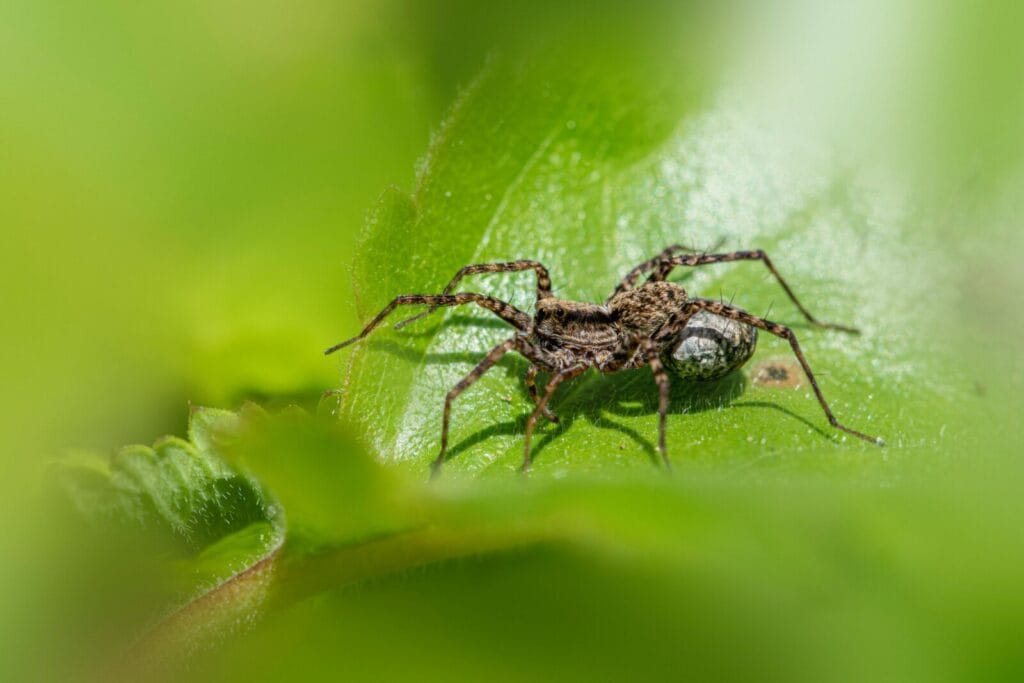
Hobo spiders are brown with a faint herringbone or chevron pattern on the top of the abdomen. The pattern is not bold. It is brownish-gray and easy to miss. The body is roughly a third to half an inch long, with a leg span of about one to two inches. Males have noticeably enlarged mouthparts that look like small boxing gloves.
The most useful field mark is what the legs do not have. Hobo spider legs are a uniform brown with no dark bands or stripes. If the spider in your bathtub has distinct dark rings on its legs, it is almost certainly a grass spider, not a hobo. Grass spiders are harmless and extremely common in Utah yards. They build similar funnel webs in lawns and garden beds and are the spider most often mistaken for a hobo.
Wolf spiders are the other common confusion. Wolf spiders are stockier, carry their young on their backs, and do not build webs. If the spider is sitting in a funnel web, it is not a wolf spider.
One more worth addressing: brown recluse spiders are not established in Utah. Every “brown recluse in my basement” report in Davis County turns out to be something else, usually a hobo, a wolf spider, or a crevice weaver. The only spider in Davis County that is genuinely medically significant is the western black widow, which is jet black with a red hourglass on the underside and looks nothing like a hobo.
If you catch a spider and want a definitive answer, the Davis County USU Extension office can help with identification.
How to Keep Them Out of Your House
Hobo spiders do not want to live inside your home. They end up there because they found a way in while wandering during mating season. The prevention strategy is straightforward: close the entry points and reduce what attracts their prey.
Door sweeps are the single most important fix. Every exterior door needs a sweep that contacts the ground fully across the entire width. Even a small gap at one corner is enough. Check the sweep on your garage door especially. Attached garages are the most common entry path into Davis County homes because the garage-to-house door rarely has a sweep at all.
Seal foundation cracks with silicone caulk. Pay attention to where utility pipes and wires enter the house, where siding meets foundation, and around basement window wells.
Replace or repair torn window screens. Install weather stripping around doors and windows where daylight is visible around the edges.
Move woodpiles, rock piles, and landscape timbers away from the foundation. These are ideal harborage within stepping distance of your walls. A clean band of open ground around the foundation gives spiders fewer places to set up before they try to move in.
Switch exterior lights near doorways to yellow or sodium vapor bulbs. Standard white lights attract the moths and insects that spiders eat. Fewer insects near the door means fewer spiders hanging around the entry point.
Inside, vacuum regularly and keep basements and garages organized. Cardboard boxes stacked on a garage floor are ideal habitat. Sealed plastic totes elevated off the floor are not.
Sticky traps placed along baseboards in basements and garages catch wandering males during the fall and give you an honest count of how many are getting in.
One more thing: egg sacs are resistant to insecticide sprays. If you see dense white sacs in window wells or against the foundation, remove them physically. That is next year’s population. A broom or a long-handled brush handles it.
What the Foundation Barrier Does and When It Goes Down
We treat hobo spiders the same way we treat the broader spider and crawling insect pressure that Davis County homes deal with every season. The approach is a residual barrier applied to the surfaces spiders cross to get inside.
Our spider treatment is a surface application to the foundation, lower windows, window wells, and attached garage. When a spider or crawling insect crosses the treated surface, the residual product kills it on contact. A single treatment holds for roughly 45 days.
We de-web before each treatment. Removing existing webs and egg sacs forces spiders to rebuild in treated zones and eliminates the eggs that spray alone cannot penetrate.
The full Exterior Spider Barrier Program runs four treatments through the year: early spring, early summer, late summer, and late fall. The late summer treatment is timed specifically for the August hobo mating migration, so the barrier is fresh when male spiders start wandering toward the foundation. The early spring treatment catches the hatch from last fall’s egg sacs before spiderlings disperse.
We have been running this program on Davis County homes for over four decades, from Farmington to Centerville to Bountiful and everywhere in between. The homes that stay ahead of the fall invasion are the ones with a barrier already in place when mating season starts. A single treatment in September works for immediate relief, but the four-treatment program keeps the barrier continuous through the months that matter.
For homes already seeing spiders inside living spaces, we offer interior pest control as a separate service. That targets crawl spaces, basement perimeters, garage interiors, and wall voids where spiders have already established. Our full pest control services page covers everything we offer, including wasp and hornet removal, ant control, and box elder bug treatment.
Are hobo spider bites dangerous to people or pets?
No. The CDC removed hobo spiders from its list of venomous species in 2017, and there is no significant scientific evidence that their bite causes necrotic skin lesions.
Are hobo spiders aggressive?
No. The old “aggressive house spider” nickname actually comes from a mistranslation of the Latin species name agrestis, which means “of the field.” Hobo spiders are fast and would rather run from you than bite.
How do I tell a hobo spider from a grass spider or wolf spider?
Hobo spider legs are uniform brown with no dark bands. If the legs have distinct dark rings, it is a grass spider, which is harmless and often mistaken for a hobo. Wolf spiders are stockier, carry their young on their backs, and build no web at all, so a spider sitting in a funnel web is not a wolf spider.
When are hobo spiders most active in Utah homes?
August through October, driven by males wandering in search of females during mating season.