
Most Davis County homeowners apply their first spring fertilizer about a month too early. The lawn shows a little green in March, the bags are stacked at the garden center, and it feels like the right time. It is not. That early feeding is one of the most common lawn care mistakes along the Wasatch Front, and it creates problems that do not show up until July.
The question of when to fertilize your lawn in spring comes down to one principle: wait for the grass to tell you it is ready. The calendar is not the signal. Soil temperature, active growth, and at least one real mowing are the signals. For Davis County, that usually means mid-April to early May, not early March.
Why Early Feeding Backfires
The green color showing up in your lawn right now is not new growth driven by fresh nutrients. It is the result of carbohydrate reserves the plant stored last fall. Penn State Extension explains that cool-season grasses store carbohydrates in their stems and crowns during fall, and that storage is what fuels spring green-up and recovery from summer stress.
When nitrogen hits a lawn that is barely awake, it forces blade growth before the root system is ready to support it. Colorado State University Extension warns that applying high-nitrogen fertilizer in April may cause grass to grow too fast before roots can grow to support the lawn, making it less tolerant of summer heat. The mechanism is straightforward: nitrogen drives leaf production, and the plant diverts energy away from root growth to keep up. The carbohydrate reserves that should carry the lawn through summer get burned on blade growth instead.
The result is a lawn that looks fantastic in late April and struggles by mid-July. The roots never reached the depth they needed. The plant goes into summer shallow-rooted, energy-depleted, and vulnerable to drought, disease, and insect pressure.
CSU adds one more point worth hearing. In most cases, an April fertilizer application is not needed when lawns were fertilized the previous fall. If your lawn got its September and November feedings last year, the reserves are already there. The spring feeding is a supporting application, not the main event.
How to Tell When Your Lawn Is Actually Ready
Rather than a calendar date, watch for three signals that all line up at the same time.
The first is soil temperature. Cool-season grass roots grow best when soil at 4 inches deep holds above 50 degrees. USU Extension’s Northern Utah Turfgrass Management Calendar, which lists Davis County by name, does not mark the first fertilizer application until May. A soil thermometer pushed 4 inches into a representative spot in your yard is the simplest way to check. One warm afternoon does not count. Several consecutive days above 50 degrees at that depth is what matters.
The second is uniform green-up. Not the first scattered green blades in a south-facing strip. The whole lawn should be consistently green, with color that is no longer patchy.
The third is real mowing. If the grass has grown enough to need cutting at your normal height of 2.5 to 3 inches, the plant is actually photosynthesizing and taking up nutrients. Most turf professionals use a two-mowing rule: wait until the lawn has been mowed at least twice before the first fertilizer application. That is not a formal university recommendation, but it operationalizes the same principle. A lawn that needs cutting is a lawn that is growing.
In a typical Davis County year, all three signals line up between mid-April and early May. Lower-elevation neighborhoods in Bountiful and Centerville tend to reach it first. Higher benches in east Kaysville, Fruit Heights, and east Layton run a week or two behind.
What Homeowners Can Do Right Now
March is not fertilizer month. It is preparation month. There are useful things to do with this time that set up the spring feeding to work better when it arrives.
Start mowing as soon as the grass needs it, even if growth is uneven. Set the mower at 2.5 to 3 inches and follow the one-third rule: never cut more than a third of the blade in a single pass. Early mowing gets the lawn into a regular rhythm and gives you a real-time read on how fast the grass is growing.
Leave the clippings on the lawn. Returning clippings recycles nitrogen back into the soil, reducing the total amount of fertilizer the lawn needs over the season. This matters most in spring when you are trying to keep nitrogen inputs light.
If you have not had a soil test in the last two or three years, order one from the USU Analytical Lab. Utah soils along the Wasatch Front are naturally high in phosphorus, which means a nitrogen-focused product is usually the right choice. A soil test confirms whether your lawn is the exception.
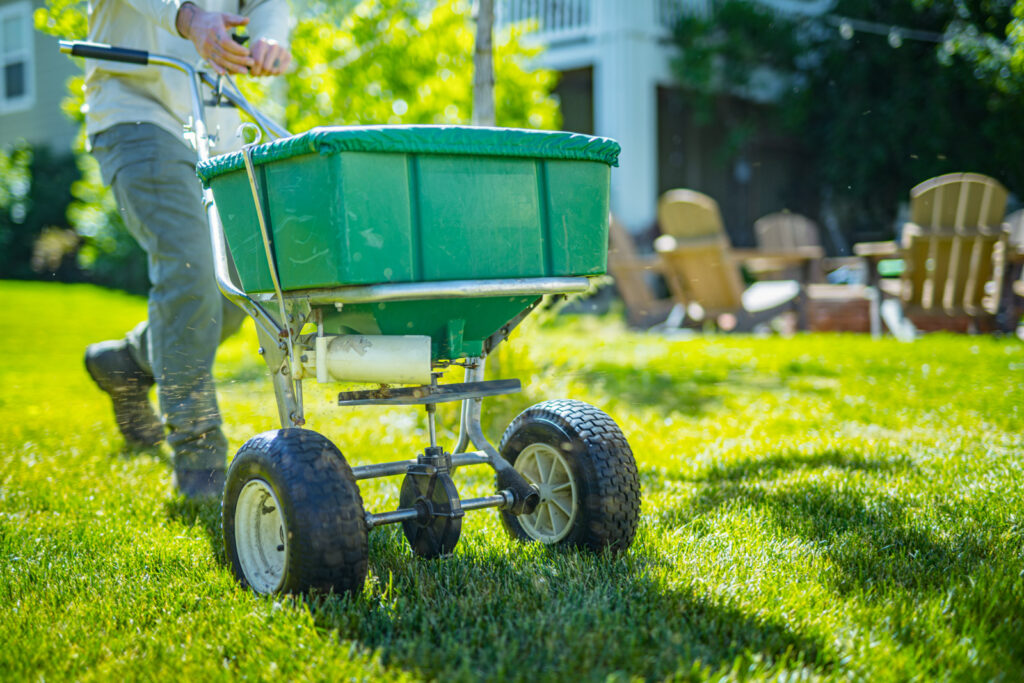
When the signals line up and it is time to feed, use a slow-release, nitrogen-focused product at a conservative rate of about 0.5 to 0.75 pounds of actual nitrogen per 1,000 square feet. Slow-release sources feed the plant over 8 to 12 weeks instead of dumping a flush that forces blade growth. Avoid “spring greenup” products that are mostly quick-release urea. Those create exactly the growth flush that causes summer problems.
One more timing note: pre-emergent weed control and the first fertilizer application are two different events with two different windows. Pre-emergent needs to go down before crabgrass germinates, which happens when soil crosses 55 degrees. That is usually late March to mid-April in Davis County. The first fertilizer waits until the lawn is actively growing, which is several weeks later. Splitting the two gives better results than combining them in a single “weed and feed” product.
How We Time the First Spring Feeding
We start our spring rounds when the lawns we are walking are actually ready, not on a calendar date. That start date shifts by two to three weeks year to year depending on how the spring unfolds.
Our first visit handles pre-emergent timing, which needs to be in the ground before crabgrass germinates. The first fertilizer application follows on a later visit, timed to active growth and soil temperature along each route. We use commercial-grade controlled-release products that allow lower per-application rates with longer residual. The nitrogen curve stays smooth through spring instead of spiking, which is the whole point of the “don’t overfeed in spring” principle translated into a professional program.
For lawns that missed their fall feeding last year, the spring application matters more, but the temptation to overcompensate is the mistake. We keep the rate conservative and plan the real correction for September, when the biology of cool-season grass favors heavy feeding. A strong fall program means the spring round can stay light and patient. That is the pattern we have been running on Davis County lawns since 1981, and the lawns that stay healthy through July and August are the ones where the spring feeding was small and the fall feeding was not.
Our lawn fertilization service handles the timing, product selection, and rate calibration across the full year. The Full Season Lawn Program builds fertilization into a multi-visit schedule alongside pre-emergent, weed control, and aeration so the pieces work together instead of competing with each other.