
By the time most homeowners buy a lawn fungus treatment, it is already too late to do much good. The fungicide goes down after the dead patches appear, which is the one moment it can help least. That is the first of two reasons store-bought fungicides so often disappoint in Davis County. The second is that the brown patch was frequently never a fungus at all.
A fungicide cannot bring dead grass back to life. At best it protects the healthy grass that is still standing. So the homeowner who waits until the lawn is visibly spotted, then sprays, is paying to protect what is left while believing they are curing what is already gone. Understanding why that happens, and what actually works instead, saves a lot of wasted money and a lot of frustration.
Why the Fungicide From the Store Did Not Work
There are two failures here, and they compound each other.
The first is timing. Lawn fungicides are mostly preventive. They work when they are present before or right at the first sign of infection, protecting grass that has not yet been attacked. They are not cures. A curative application on an active infection can slow it and shield the living tissue, but it cannot reverse the damage already done. The homeowner buys fungicide the day the dead patch appears, which is the day its usefulness is mostly behind it.
The second failure is misidentification, and it is the more expensive of the two. A brown patch in a Utah lawn can be a lot of things. It can be drought stress, summer dormancy, grub damage, dog urine, fertilizer burn, a dull mower blade, or a sprinkler head that quit covering a strip. None of those respond to fungicide. Spraying a fungus product on a grub problem or a dry spot does exactly nothing except cost money. Even when it truly is a disease, different fungi need different chemistry, so a broad product off the shelf may not match the specific disease on your lawn.
Stack those together and you get the common outcome: a homeowner applies a single bag of fungicide, at the wrong time, possibly to the wrong problem, without watering it into the root zone where it needs to be, and sees no improvement. The product did not fail because fungicides do not work. It failed because every part of the application was off.
Is It Even a Fungus, and Did You Already Miss the Window?
Before spending a dollar on any treatment, the real question is whether you have a disease at all, and if you do, whether the treatment window is still open.
Start by ruling out the things that are not disease. Grass killed by grubs or by a root disease pulls up easily, because the roots are gone. Tug a handful. If it lifts like loose carpet, you are likely looking at grubs or root rot, not a foliar fungus, and the response is different. Uniform browning across the whole lawn that recovers when you water is dormancy or drought, not disease. A dead spot ringed by darker green is dog urine. Brown following the stripes of your spreader is fertilizer burn. We covered how to tell the common Davis County diseases apart in detail in our post on spotting brown circles and lawn fungus, and that is the place to start if you are trying to identify what you actually have.
Then there is the timing trap, and this is the heart of the matter for our two worst local diseases. Necrotic ring spot and summer patch are both root diseases. The fungus infects the roots of Kentucky bluegrass in spring, when the soil warms, but the symptoms, the brown rings and the frog-eye patches with a tuft of green in the center, do not surface until the heat of July and August. By the time you see them, the roots have already been damaged for weeks or months. The window to treat preventively was back in spring.
That window is set by soil temperature, not the calendar. Preventive treatment for these root diseases begins when the soil temperature at the two-inch depth holds around 65 degrees for several days in a row, with a second application about a month later. Along the lower Wasatch Front in Davis County, that soil trigger usually arrives around mid-May. The lawn that browns in late July needed treatment roughly two months earlier. Watch soil temperature rather than the date on the calendar, because a cold spring pushes that window later and a warm one earlier. This is the single most important thing to understand about treating these diseases: the symptoms and the treatment window are months apart.
What You Can Do That Actually Helps
Here is the honest part. For most lawns, the things that control disease are not chemical at all. They are cultural, and they do more than any bottle from the shelf.
Most lawn disease is driven by stress and moisture. Fix those and the disease often disappears on its own. The biggest lever in Utah is watering. Lawns here are chronically overwatered by automatic timers that never change from April to August, and evening or night watering leaves the blades wet for hours, which is exactly what fungus needs. Water deeply, infrequently, and early in the morning so the grass dries as the sun comes up. For a lot of lawns, that single change ends the disease problem.
The rest of the cultural toolkit reinforces it. Mow tall, around two and a half to three inches, with a sharp blade, because taller grass grows deeper roots that resist root disease better. Avoid heavy, fast-release nitrogen in spring, which pushes tender growth that disease feeds on, and use balanced slow-release fertility instead, which ties back to what we covered in the fertilization post. Reduce thatch and relieve compaction with core aeration, since both root diseases thrive in compacted, thatchy soil. And if a bluegrass lawn keeps getting hit, overseeding with perennial ryegrass helps, because ryegrass does not get necrotic ring spot and fills in over the damage.
There is one exception worth knowing, because it shows why diagnosis matters. The normal rule is never to water in the heat of the day. But once necrotic ring spot or summer patch symptoms are already present, the rotted roots cannot pull water, so a light midday watering of the affected areas only can help the surviving grass make it through the heat. That is the opposite of the usual advice, and it only applies to those specific diseases once they have shown up. It is a good example of why knowing exactly what you have changes what you should do.
When to Stop Guessing and Call Us
There is a point where DIY stops making sense, and it usually comes down to diagnosis and timing, which are exactly the two things store-bought treatment gets wrong.
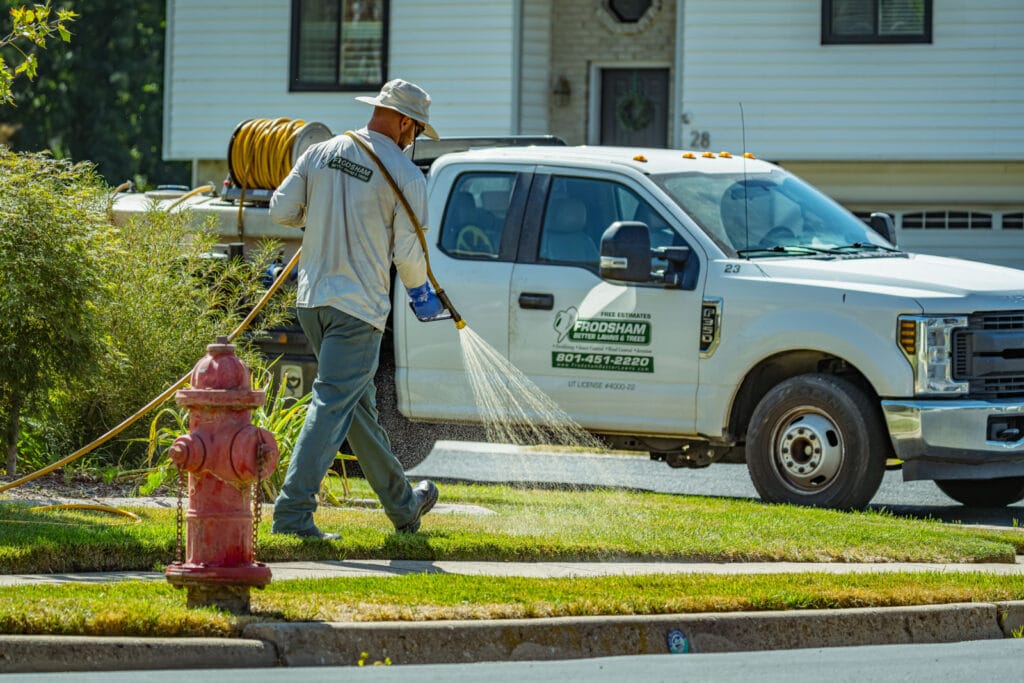
Call us when you cannot confidently identify the problem. Diagnosis comes first, and sometimes the answer is that it is not a disease at all but an irrigation problem, which saves you from buying fungicide entirely. Call us when you have confirmed necrotic ring spot or summer patch, or a multi-year history of brown rings returning in the same spots every summer. Those root diseases need professional-grade systemic fungicides applied preventively in spring on a soil-temperature schedule, watered into the root zone, repeated on a monthly interval, with the active ingredients rotated so the fungus does not build resistance. Most of the products that actually work on these diseases can only be applied by a licensed applicator, which is a large part of why the store versions disappoint. And call us when the damage is spreading or large, because even coverage across a whole lawn is hard to get right by hand.
The value we bring is the whole package that DIY misses: correct diagnosis, correct timing keyed to soil temperature, the correct product at the correct rate, and proper application, combined with the cultural corrections that make any fungicide work and often make it unnecessary. We have been diagnosing and treating Davis County lawns since 1981, and a fair amount of the time the most valuable thing we do is tell a homeowner their brown patch is a sprinkler problem, not a disease, before they spend money treating the wrong thing.
Our fungus control service starts with diagnosis and uses preventive timing rather than a too-late curative spray. You can see everything we offer on the lawn care services page, read more about core aeration for the cultural side of disease control, or request a free estimate and we will take a look before you treat.
One honest caveat: even done right, control of necrotic ring spot is inconsistent, and the goal is to suppress and manage it over several seasons rather than erase it in one. Cultural correction and resistant overseeding are not optional extras. They are what make the treatment hold.