
The brown ring showing up in your lawn this month started growing underground last fall. Most Davis County homeowners see brown circles and assume drought. They drag the hose over and give it more water. That instinct is wrong, and the extra moisture usually makes the problem worse.
Brown circles in Davis County lawns are almost always fungal disease. The ring-with-a-green-center pattern has a specific name, a specific cause, and a specific treatment window that is closing right now. Getting the diagnosis right matters because the three most common lawn diseases in Northern Utah look different, act different, and respond to completely different fixes.
The Name on the Search Engine Is Probably Wrong
Most homeowners Google “brown patch lawn” when they see dead circles in the grass. The problem is that true brown patch disease is caused by a fungus called Rhizoctonia, and it needs warm, humid nights above 65 degrees to thrive. That describes Alabama, not Bountiful.
Utah State University Extension lists the common turfgrass diseases in Utah: snow mold, melting out, necrotic ring spot, summer patch, fairy ring, and powdery mildew. Rhizoctonia brown patch is not on the list. University of Idaho Extension puts it plainly: home lawns in the dry Intermountain West are generally not faced with the same disease problems as humid climates.
What Davis County homeowners are actually seeing when they search “brown patch lawn” is one of three things: necrotic ring spot, dollar spot, or fairy ring. Here is how to tell them apart.
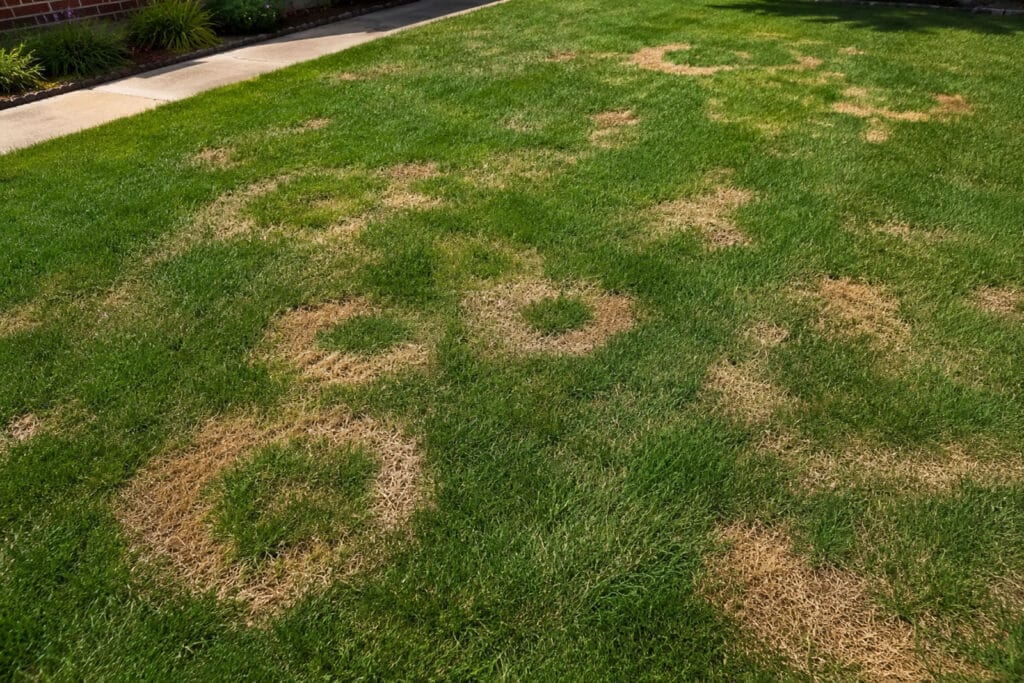
Necrotic Ring Spot: The Frog-Eye in Your Bluegrass
This is the one behind most brown circles along the Wasatch Front. USU’s Center for Water-Efficient Landscaping reports that necrotic ring spot is the most commonly diagnosed fungal turfgrass disease at the Utah State University Plant Pest Diagnostic Lab. Colorado State University Extension calls it the most destructive disease of Kentucky bluegrass in the region.
The visual pattern is distinctive. The fungus kills grass roots and crowns in a roughly circular zone. Over time, healthy grass recolonizes the center of the dead area from the edges inward. The result is a ring of straw-colored dead grass with a tuft of green in the middle. Extension publications call this the “frog-eye” or “doughnut” pattern. Rings typically range from a few inches to two or three feet across.
Here is the part that trips up homeowners. The infection happens in spring and fall when soil temperatures sit between 60 and 70 degrees at a few inches deep. That is exactly where Davis County soil is right now in early May. But the visible symptoms do not appear until July or August, when heat and drought stress push the damaged grass over the edge. By the time you see the brown ring in mid-summer, the fungus has been working underground for months.
This timing gap is why curative fungicide applications almost never work for necrotic ring spot. The fungicide has to go down in spring, before the pathogen colonizes the roots. Active ingredients like azoxystrobin and propiconazole are preventive tools, not rescue tools. If you are reading this in early May and you see the frog-eye pattern forming, the preventive window is still open but closing fast.
Cultural management helps too. Aerate compacted soil to reduce thatch. Water deeply and less often instead of running sprinklers every day. Mow at 2.5 to 3 inches. Use slow-release nitrogen instead of heavy spring fertilizer flushes. Davis County’s heavy clay and the habit of light, frequent irrigation are exactly the conditions that favor this disease.
Dollar Spot: Silver Coins in the Morning Dew
Dollar spot gets confused with early-stage necrotic ring spot, but a sunrise walk will settle it. This disease produces small, sunken, tan spots roughly the size of a silver dollar, one to three inches across. Instead of rings with green centers, you get dozens of small dots scattered across the lawn.
The diagnostic giveaway is the fine, white, cobweb-like fungal growth that wraps around the grass blades in the early morning while dew is still on the lawn. Walk out at sunrise. If you see a thin web shimmering across the spots, it is dollar spot. The web disappears within an hour or two once the sun hits it.
Dollar spot favors temperatures between 60 and 80 degrees with some humidity, which makes spring and fall the prime seasons. Utah’s dry air keeps it at lower severity than in humid states. The most useful fact for Davis County homeowners is that dollar spot is strongly associated with under-fertilized lawns. In many cases, a balanced nitrogen application fixes the problem without any fungicide at all. Feed the lawn, and the dollar spot often resolves on its own.
Fairy Ring: The Dark Green Halo
Fairy ring is the one that looks strange but is usually harmless. Various soil fungi break down buried organic matter, old roots, wood chips, or construction debris. As the fungus feeds, it releases nitrogen into the soil above it. The grass growing over the fungus gets an extra dose of nitrogen and turns dark green, creating a visible ring or arc of lush growth.
The most common version Davis County homeowners notice is called Type II: a ring of dark green grass with no dead zone, sometimes with mushrooms popping up after rain. The grass inside and outside the ring looks normal. The ring itself is simply greener and growing faster than the rest of the lawn.
Type II fairy ring is cosmetic. The lawn is healthy. The frustrating part, documented by both USU Extension and University of Idaho Extension, is that fungicide drenches give inconsistent results on fairy ring and are generally not recommended for home lawns. The standard approach is core aeration through the ring, deep watering to push moisture past the fungal mat, and balanced fertilization to mask the color difference. For the rare destructive Type I ring that kills grass in a dead zone, soil removal and replacement is sometimes necessary.
Reading the Ring Before July
The brown circle you are looking at right now tells you what to do next. If the ring has a green center on Kentucky bluegrass that is three or more years old, it is almost certainly necrotic ring spot. The preventive fungicide window is open now but closes within the next few weeks. If you see dozens of small tan spots with a web of white threads at dawn, it is dollar spot, and a nitrogen feeding is your first move. If the ring is greener than the rest of your lawn, it is fairy ring, and the lawn is fine.
The pattern that matters most in Davis County is necrotic ring spot. It is the most common, the most destructive, and the only one where the treatment window closes before the symptoms fully appear. Our fungus control service handles the diagnostic visit, the preventive fungicide timing, and the cultural corrections that break the cycle. For lawns with recurring NRS, the Fungus and NRS Lawn Program bundles preventive applications across the spring infection window. Broader lawn health support, including the fertilization and aeration work that reduces disease pressure over time, sits inside our full-season programs.
Is fairy ring harmful to my lawn?
Usually not. The most common version, Type II, is just a ring of darker green grass with no dead zone, since the fungus releases nitrogen that the grass above it uses. The lawn stays healthy; it is a cosmetic difference, not damage.
What is the difference between necrotic ring spot and dollar spot?
Necrotic ring spot shows as a ring of straw-colored dead grass with a green tuft in the middle, a few inches to a few feet across. Dollar spot shows as dozens of small, silver-dollar-sized tan spots, with fine white cobweb-like fungal growth visible at sunrise before the sun burns it off.
Can I still treat necrotic ring spot once I see the brown rings in summer?
The window is mostly closed by then. The fungicide has to go down in spring, before the pathogen colonizes the roots, since products like azoxystrobin and propiconazole are preventive tools for this disease, not rescue tools.
Why do the brown rings show up in July if the infection started in spring?
Infection happens in spring and fall when soil temperatures sit between 60 and 70 degrees a few inches down, but symptoms do not appear until heat and drought stress push the already-damaged grass over the edge in July or August. By the time you see the ring, the fungus has usually been working underground for months.