
Spongy turf that lifts off the ground like loose carpet is one of the clearest signs of grubs in a lawn. The roots are gone. Something has been chewing through them from below, and the brown patches keep spreading no matter how much water they get.
By mid-May in Davis County, the damage from missed spring prevention starts showing up in exactly this way. The turf feels loose underfoot. Birds, skunks, or raccoons start tearing up sections of lawn overnight to get at whatever is feeding underneath. The lawn looks like a drought problem, but water makes no difference.
This guide helps you confirm whether grubs are the cause, figure out which type you have, and understand what realistic treatment looks like at this point in the season.
Confirming the Damage Is Actually Grubs
Not every brown patch is grub damage. Drought stress, fungal disease, dog spots, and compaction all create brown areas that can look similar from a distance. The difference is underground.
The simplest test is to grab a section of brown turf and pull. If the grass lifts easily with no roots attached, something has been feeding on the root system. Drought-stressed grass holds tight to the soil because the roots are still intact. Grub-damaged turf separates because the roots have been chewed through.
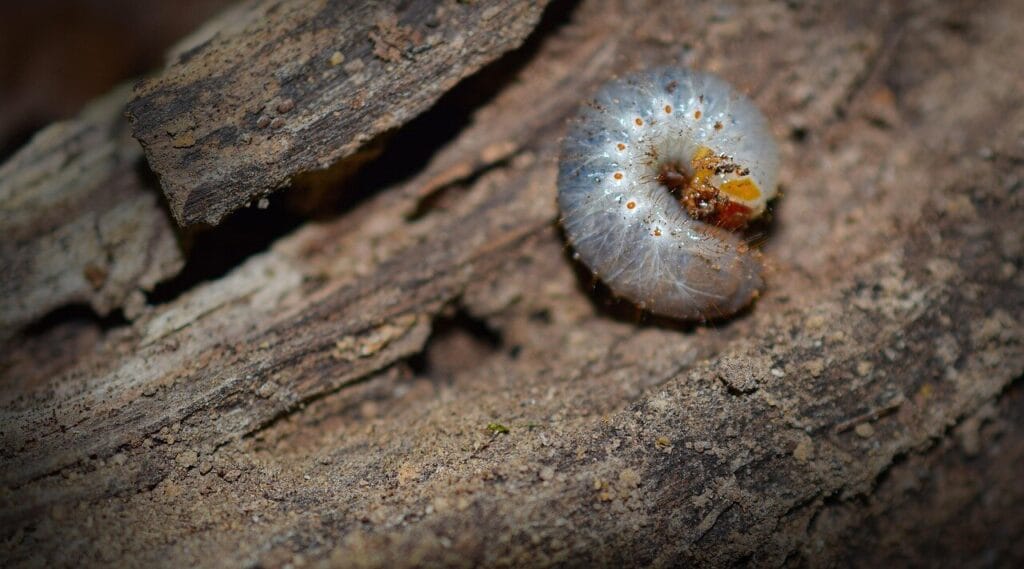
To confirm, USU Extension recommends cutting a one-foot square of turf on three sides with a hand trowel and peeling it back. Sift through the top two to three inches of soil underneath. If you find white, C-shaped larvae with three pairs of legs near the head, you have white grubs. Count them. USU sets treatment thresholds at 8 to 10 per square foot for masked chafer grubs, or 3 to 5 per square foot for larger May and June beetle larvae.
Animal activity is another strong signal. Skunks and raccoons can smell grubs underground and will tear up sections of lawn to feed on them. Colorado State University Extension notes that vertebrate digging can start at population levels well below the turf-damage threshold. If something is ripping up your lawn at night, grubs are the likely reason.
Billbugs or White Grubs: Two Different Problems
Davis County lawns deal with two main types of root-feeding larvae, and knowing which one you have changes what happens next.
White grubs are the classic C-shaped larvae most homeowners picture. They are off-white with a brown head and three pairs of visible legs. They feed entirely on roots in the soil and are most active from June through September. Damage shows up as irregular brown patches that feel spongy and lift like carpet.
Billbug larvae look different. They are smaller, cream-colored, legless, and have a tan head capsule. USU Extension’s billbug fact sheet describes the key diagnostic: damaged turf breaks off at the crown when tugged upward, revealing sawdust-like frass within hollow stems. Billbug larvae start by feeding inside grass stems before dropping to the soil to feed on roots. Their damage typically shows up earlier in summer than white grub damage.
The distinction matters because the treatment timing differs. Billbug damage appearing in May is often from larvae that have already finished feeding inside stems and moved to roots. White grub damage in May is less common in Northern Utah because most white grub species are still pupating at this point. If you are seeing damage right now and the stems have sawdust-like frass, billbugs are the more likely cause.
What Homeowners Can Do Right Now
While you figure out your treatment plan, there are cultural steps that help the lawn fight back and recover.
Water the damaged areas deeply and less frequently. Daily light watering keeps the soil surface warm and moist, which is exactly what grubs prefer. Switching to deep, infrequent irrigation encourages whatever surviving roots exist to grow deeper. That matters more right now than anything you spray.
Mow at 2.5 to 3 inches. Taller grass shades the soil, holds moisture, and supports the root system. Short-mowed lawns lose ground faster to grub feeding because there is less plant left to recover from.
Avoid heavy nitrogen fertilization on damaged turf during summer heat. Pushing top growth when the root system is compromised makes the problem worse. Save the fertilizer for fall when conditions favor recovery.
The honest reality with DIY grub products from the garden center is that most of them are contact-kill formulations. They need to physically touch the grub to work. Utah’s clay soils along the Wasatch Front run alkaline, typically pH 7.5 to 8.3. Contact-kill products break down fast in alkaline conditions. By the time the product moves through the thatch and reaches the root zone where grubs are feeding, much of it has already degraded. That is why many Davis County homeowners feel like grub products “do not work.” The products are doing what they were designed to do. They just were not designed for this soil.
How We Handle Grub Damage in Davis County
The reason professional grub treatment works differently is the product chemistry. We use systemic insecticides, not contact-kill. A systemic product is absorbed by the grass plant and moves into the stems and roots. The grub has to eat treated plant material to be affected. The active ingredient reaches the pest through ingestion, not through soil contact.
This matters in Davis County for a specific reason. A systemic product does not need to survive sitting in alkaline soil long enough to bump into a grub underground. The grass absorbs it, the grub feeds on the grass, and the chemistry does its job inside the insect. The soil pH problem that defeats most garden-center products is not a factor.
We time applications to soil temperature and insect emergence along the Wasatch Front. Billbugs and white grubs follow predictable development cycles tied to how the soil warms each spring. We have been treating lawns in Layton, Woods Cross, and North Salt Lake for more than 40 years, and the timing patterns hold: a properly scheduled systemic application in spring prevents the damage you are looking at right now in May.
For lawns already showing damage, the path forward has two parts. First, we assess whether active larvae are still feeding and whether a mid-season systemic application can reduce the population before more turf is lost. Second, we plan the recovery. Brown patches where grubs destroyed the root system need overseeding in September, ideally paired with core aeration to give seed direct contact with the soil. Our grub control service handles both the current-season treatment and the preventive schedule for next spring. For lawns with recurring pressure across billbugs, white grubs, and sod webworm, our lawn insect control program covers the full season under one schedule.