
Every wasp colony in Davis County started the same way: one queen, one sheltered surface, and a nest the size of a quarter. Right now in mid-May, most of those nests are exactly that small. A few papery cells, a single insect, no swarm. By August, a yellow jacket colony built from that same starter nest can hold a thousand workers or more.
That math is the entire case for spring wasp removal. The queen emerges from her overwintering spot in April or early May, finds a protected surface under an eave or inside a wall void, and builds alone. She lays the first eggs, raises the first workers, and grows the colony through summer. Remove the nest while it is one queen and a handful of cells, and the problem is over in thirty seconds. Wait two months, and you are calling for professional help.
How Wasp Colonies Build Through Summer
Three types of social wasps cause problems around Davis County homes. Knowing which one you have helps you decide what to do.
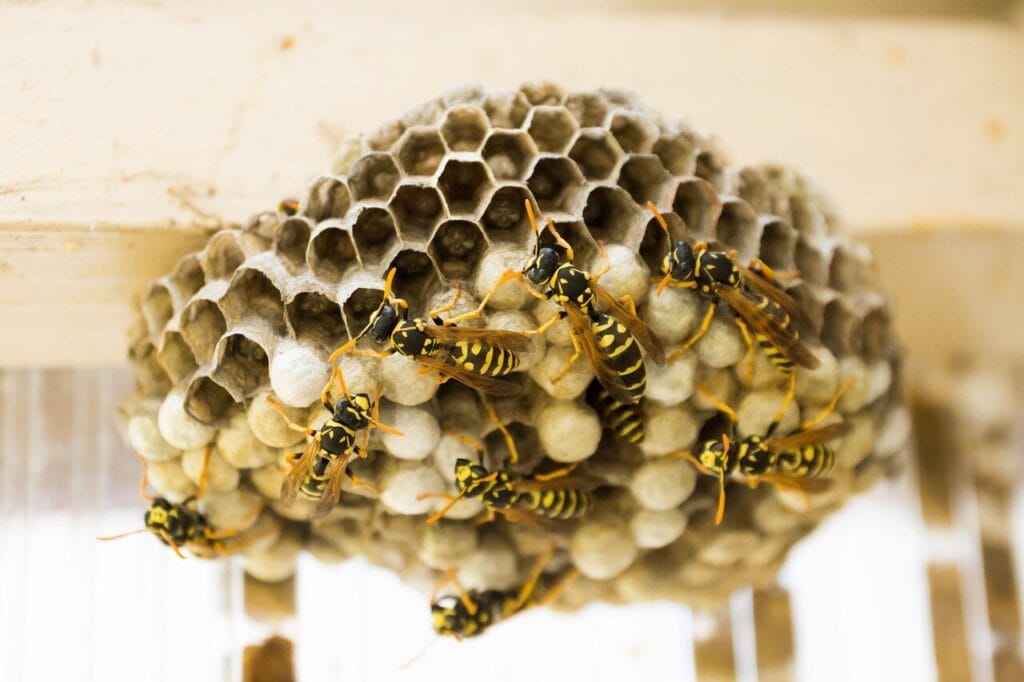
Paper wasps are the most common. They build open, umbrella-shaped nests under eaves, porch ceilings, deck rails, and inside hollow pipes and play equipment. USU Extension notes that paper wasp colonies are relatively small, typically topping out at 20 to 30 adult workers. They are not aggressive unless the nest is disturbed directly, and their nests are easy to spot because the comb hangs in the open.
Yellow jackets are the aggressive ones. The western yellow jacket is what USU Extension calls a particularly important stinging insect in Utah. They nest underground in old rodent burrows, inside wall voids, and in attic spaces. Their colonies grow much larger than paper wasp colonies. UC IPM documents mature yellow jacket colonies reaching 1,500 to 15,000 workers depending on species. By late summer, these colonies are at peak size and peak aggression.
Washington State University Extension explains the aggression shift clearly. Late in the season, the colony queen dies and there are no more developing larvae to feed. The workers stop gathering protein and start searching for sugar instead. That is when yellow jackets show up at your barbecue, your soda can, and your garbage bins. The aggressive behavior people associate with wasps is mostly a late-summer and early-fall phenomenon driven by a colony that is large, queenless, and hungry.
One clarification worth making: the bald-faced hornet is technically a yellow jacket, not a true hornet. No true hornets in the genus Vespa are established in Utah. The large black-and-white wasp building football-sized nests in trees is a Dolichovespula, and while it is aggressive when its nest is disturbed, it is less common around homes than paper wasps or yellow jackets.
What You Can Do Right Now
May is the window for prevention. The queens have emerged and the nests are just getting started. USU Extension’s social wasp fact sheet recommends reducing nesting sites before the colonies become established in early spring. Here is what that looks like for Davis County homeowners this month.
Walk the exterior of your home and check under every eave, soffit, porch ceiling, and deck railing. Look inside open pipes, light fixtures, grill covers, and unused play equipment. Paper wasp nests at this stage are small and obvious. A new nest with a few cells and one queen can be knocked down with a broom or a blast of water from the hose. After removal, wash the spot with soap and water. USU notes that cleaning the attachment site removes pheromones that attract queens back to the same location.
For yellow jackets, the inspection is different. Watch for wasps flying into the same spot repeatedly at ground level, near foundation walls, or around rock piles. A single wasp disappearing into a hole in the yard over and over is a queen entering a ground nest. Filling old rodent burrows and sealing exterior cracks before queens move in is far easier than removing an established colony later.
One important safety rule from USU: never plug the entrance hole to an active yellow jacket or wasp nest. The wasps will find another way out, often through interior walls and into your living space. Sealing entry points works as prevention before a queen moves in. It does not work as treatment after a colony is established.
Not Every Wasp Needs Removal
Mud daubers deserve a brief mention because they cause the most unnecessary alarm. These solitary wasps build small tube-shaped mud nests on walls and under eaves. They are not aggressive and rarely sting. They are also beneficial predators that feed on spiders.
Colorado State University Extension notes that solitary wasps like mud daubers do not defend their nests the way social wasps do. If the nest is in a high-traffic area and you want it gone, you can scrape it off with a putty knife. But if it is tucked under an eave where nobody walks, leaving it alone is a reasonable choice. Fewer spiders around the house is a side benefit worth having.
The Nest You Handle Now vs. the One You Handle in August
The difference between a May nest and an August nest is not just size. It is risk. A queen working alone on a quarter-sized nest does not sting unless you physically grab her. A colony of several hundred workers defending a ground nest or a wall void will sting repeatedly and in numbers. Yellow jacket stings are the leading cause of insect-related ER visits in the intermountain west, and the risk goes up with colony size.
If the nest you find is already larger than a fist, has visible worker traffic coming and going, or is located inside a wall or underground, that is past DIY territory. CSU Extension notes that ground nests can extend well beyond the visible entrance, and repeated insecticide applications are often required to reach the colony. Our wasp and hornet treatment service handles the nests that are beyond a broom and a bucket of soapy water. For yellow jacket ground nests and wall-void colonies, professional removal is the safer and more reliable option.
The colony dies on its own with the first hard freeze in fall. Only newly mated queens survive the winter, and they start the cycle over again next spring. That means the prevention window you have right now comes back every year. Walk the eaves in May, knock down the small nests, seal the entry points, and the August problem often never materializes. If it does, our pest control services are built for exactly that call.
Are wasp stings dangerous?
Yellow jacket stings are the leading cause of insect-related ER visits in the intermountain west, and the risk goes up as a colony grows larger through the summer.
Should I plug or seal the entrance hole to a wasp nest?
No. Never plug an active nest entrance. The wasps will find another way out, often through interior walls and into living space. Sealing entry points works as prevention before a queen moves in, not as treatment after a colony is already established.
Are mud dauber nests something to worry about?
Not really. Mud daubers are solitary, do not defend their nests the way social wasps do, and rarely sting. They are also beneficial predators that feed on spiders. If the nest is not in a high-traffic spot, leaving it alone is a reasonable choice.
What is the best time of year to remove a wasp nest?
Spring, while the colony is still just one queen and a handful of cells. At that stage it can be knocked down with a broom or a blast from the hose in seconds. Wait until August and that same nest can hold a thousand workers or more.