
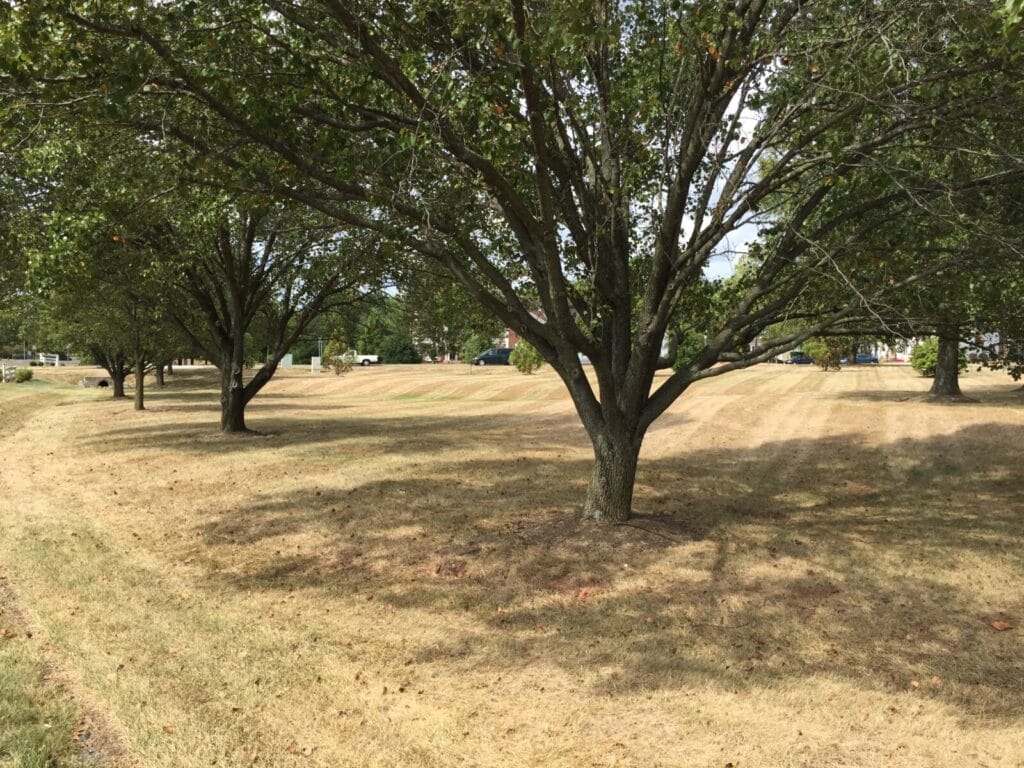
The brown lawn that has you worried in July is almost certainly not dead. Kentucky bluegrass turns brown in summer heat on purpose. It is a survival mechanism, and the grass is protecting itself by going dormant. The crown, the growing point at the soil surface, stays alive underground while the blades go tan to conserve energy and water.
This matters because the panic response makes things worse. Homeowners see brown grass and either drown it with daily watering or give up on it entirely. Both responses can do more damage than the heat. Understanding what your lawn is actually doing in summer is the difference between helping it through the season and fighting against it.
Here is how to read summer heat stress, water correctly, mow correctly, and feed without burning your lawn.
Brown Is Not Always Dead
Kentucky bluegrass is a cool-season grass. It evolved for spring and fall growing conditions, and it slows down or goes dormant when temperatures climb past the mid-80s. Dormancy is not death. It is the plant pulling resources down to the crown and waiting out the heat.
The good news for Davis County is that Kentucky bluegrass recovers from dormancy better than almost any other lawn grass. It spreads by underground rhizomes, which gives it the ability to regenerate blades once conditions improve. A bluegrass lawn that browns in July will typically green back up within two to three weeks of cooler weather and returning moisture. Perennial ryegrass and fine fescue, which are mixed into some lawns, do not bounce back as reliably, but the bluegrass that dominates most local lawns is built for this.
Two quick tests tell you whether brown grass is dormant or actually dead. The first is the tug test. Grab a handful of brown grass and pull. If it resists and stays rooted, it is alive and dormant. If it lifts out easily with almost no resistance, the roots are gone and that section is dead. The second is the crown check. Part the blades and look right at the soil line. A firm, whitish or pale green crown means the plant is alive. A brown, dried, mushy crown means it is dead.

When Brown Means Something Worse
The single most useful thing to know about summer browning is that dormancy is uniform and trouble is patchy.
If your whole lawn browns evenly, that is heat-stress dormancy. It is normal and it recovers. If the browning shows up in distinct patterns, something else is going on.
Circular brown rings or patches with a green center, sometimes called frog-eye patches, point to a fungal disease like necrotic ring spot or summer patch. This is a disease problem, not a watering problem, and pouring on more water often makes it worse. We cover this in detail in our post on brown circles and lawn fungus.
Irregular patches where the turf pulls up like loose carpet, often with birds or skunks digging at night, point to grub damage. Grubs feed on roots in mid to late summer, and grub-damaged turf does not recover with more water because the roots are gone. Our post on grubs walks through that diagnosis.
Brown spots with a darker green ring around the edge, usually in a dog’s favorite corner of the yard, are pet urine. The concentrated nitrogen burns a dead center while fertilizing a green halo. Flush those spots deeply with water.
The test is simple. If watering returns and the brown greens up within a couple of weeks, it was dormancy. If specific patches stay brown while everything else recovers, that is your signal to look closer or have someone diagnose it.
How to Water Through the Heat
The rule for summer watering is deep and infrequent, never shallow and daily. Light daily watering trains roots to stay near the surface, which makes the lawn more vulnerable to heat, not less. Deep soaking drives roots down where the soil stays cooler and holds moisture longer.
An established Kentucky bluegrass lawn needs roughly 1 to 1.5 inches of water per week in summer, climbing toward 2 inches during the hottest stretches of July and August. Bluegrass is one of the thirstier lawn grasses, partly because its root system runs shallower than some alternatives.
Water early in the morning, between about 4 and 8 a.m. Morning watering loses the least to evaporation and lets the blades dry quickly once the sun is up, which starves the fungal diseases that thrive on grass left wet overnight. Avoid evening and night watering for that reason.
On Davis County clay, cycle and soak is essential. Our clay holds water well but takes it in slowly. Run a single long cycle and most of the water sheets off into the gutter before it can soak in. Instead, split each zone into two or three shorter cycles with about 30 minutes between them. The first cycle wets the surface, and the following cycles push water down into the root zone without runoff.
Calibrate your sprinklers so you know what they actually deliver. Set a few straight-sided cups or empty tuna cans across a zone, run it, and time how long it takes to collect a half inch. Every system is different, and this is the only way to know how long to run yours.
Watch the lawn for signals. Footprints that stay visible after you walk across, a dull blue-gray cast, and folded or wilting blades all mean the lawn is thirsty. Soggy ground hours after watering, mushrooms, and a spongy feel mean you are overwatering, which invites disease and is just as harmful as watering too little.
In a dry year with water restrictions, you have a legitimate choice. You can keep the lawn green, which takes the most water, or you can let it go dormant on purpose and keep the crowns alive with about an inch of water per month. Both are valid. The one thing to avoid is bouncing the lawn in and out of dormancy by starting and stopping green-up, which stresses it more than a steady dormant stretch.
Mowing and Feeding Without Doing Harm
How you mow in summer matters as much as how you water. Raise the mower deck to 3 to 3.5 inches and keep it there through the hot months. Taller grass shades the soil, cuts evaporation, encourages deeper roots, and crowds out weeds. This single adjustment is one of the most valuable things you can do, and it costs nothing.
Never remove more than a third of the blade height in one mowing. Keep the blade sharp, because a dull blade tears the grass and leaves frayed tips that lose more water and invite disease. Mow in the cool of the morning or evening rather than midday heat, and leave the clippings on the lawn. Short clippings return moisture and nutrients to the soil and act as a light slow feeding. If the lawn is fully dormant, avoid mowing it at all, because foot traffic and mower wheels damage stressed crowns.
Summer feeding is where homeowners do real harm. Quick-release liquid nitrogen in the heat forces tender new growth the plant cannot support, and it can burn Kentucky bluegrass outright. If you feed in summer, use a slow-release nitrogen that releases steadily over weeks, and reduce the rate compared to spring and fall. Iron is the better summer choice for color, because it deepens the green without pushing the excess top growth that nitrogen drives. Never fertilize dormant grass. It is wasted product and added stress. Wait until the lawn greens up.
How We Carry Lawns Through the Worst of It
We have watched Davis County lawns go brown in July and green back up in September for over four decades. That experience is the main thing we bring to a summer lawn. We know the difference between a lawn that is dormant and fine, a lawn that has a disease, and a lawn that is losing roots to grubs, and we can tell you which one you have before you spend money treating the wrong thing.
When we feed a lawn in summer, it is a slow-release granular fertilizer applied at a heat-appropriate rate, paired with iron for color. The late-summer visit goes a step further with a soil treatment built specifically for heat: a wetting agent that helps water penetrate our tight clay instead of running off, and a water-retention agent that helps the soil hold moisture between waterings. Every part of that visit is designed to protect the lawn through the hardest stretch of the year rather than push it to grow when it cannot.
Our Full Season Lawn Program is built around this seasonal logic, with the summer visits shifting to slow-release feeding and heat protection rather than the growth-focused applications of spring and fall. If you would rather handle the program yourself but want help diagnosing a problem spot, our lawn care services page covers everything we offer, and our fungus control service handles the disease problems that sometimes hide behind what looks like ordinary summer browning.
The honest bottom line on summer lawn care in Utah is that the grass is tougher than most homeowners think. Water it deeply, mow it high, feed it carefully or not at all, and let dormancy do its job. The lawn knows how to survive a Utah summer. Your job is mostly to avoid getting in its way.