
If you anchor your whole lawn maintenance routine on one habit, make it this: mow your Kentucky bluegrass tall, at three and a half to four inches. Most Davis County lawns are cut too short, and almost every problem that follows, thin turf, creeping weeds, a lawn that browns the moment it gets hot, traces back to that one mistake. Get the height right, keep a sharp blade under the deck, cut clean edges, and water deep instead of often, and you have a lawn that mostly takes care of itself.
We have spent more than 40 years caring for lawns across Davis County, and these are the four fundamentals we come back to again and again. None of them require a professional. They require the right technique and the discipline to stick with it. Here is how each one works and why it matters in Utah’s climate.
Mow Tall: Three and a Half to Four Inches
Kentucky bluegrass is the grass in nearly every yard on the Wasatch Front, and it is a cool-season grass that does its best work when you leave it tall. For Utah’s hot, dry, high-elevation summers, the right cutting height is three and a half to four inches. That is taller than most people mow, and the difference it makes is not subtle.
The reason comes down to roots. Taller grass grows deeper roots, and deeper roots reach water further down in the soil. When July turns hot and dry, a lawn with deep roots stays green and a lawn with shallow roots goes thin and weak. Mowing tall is the closest thing there is to a free upgrade on drought resistance, because the height of the grass above the ground directly sets how deep the roots go below it.
Height also controls weeds. A tall, dense stand of grass shades the soil surface, and most weed seeds, crabgrass especially, need sunlight hitting bare soil to germinate. Keep the canopy tall and you starve those seeds of the light they need. The grass becomes its own weed barrier. Cut it short and you do the opposite: you open the soil to sunlight and hand the weeds an invitation.
The rule that governs all of this is the one-third rule. Never remove more than a third of the grass blade in a single mowing. If your lawn is four inches tall, do not cut below about two and a half to three inches in one pass. Taking more than a third at once shocks the plant, forces it to burn stored energy regrowing leaf tissue, and starves the roots while it recovers. If the lawn gets away from you and grows long, bring it down over a few mowings rather than scalping it in one.
That one-third rule also sets your mowing frequency for you. Instead of mowing on a fixed day, mow when the grass has grown about a half inch past your target height. In the fast growth of spring and fall that might be every five to seven days. In the heat of summer, when bluegrass slows down, it stretches out. The grass tells you when it needs cutting if you let the height be your guide. Leave the clippings on the lawn when you can. They return moisture and nutrients to the soil and do not cause thatch.
One seasonal note: raise the deck to the top of the range, closer to four inches, through the heat of summer to get the most shade and root protection. The only time to cut short is the very last mow of fall, dropped a notch to help the lawn go into winter clean and avoid snow mold.
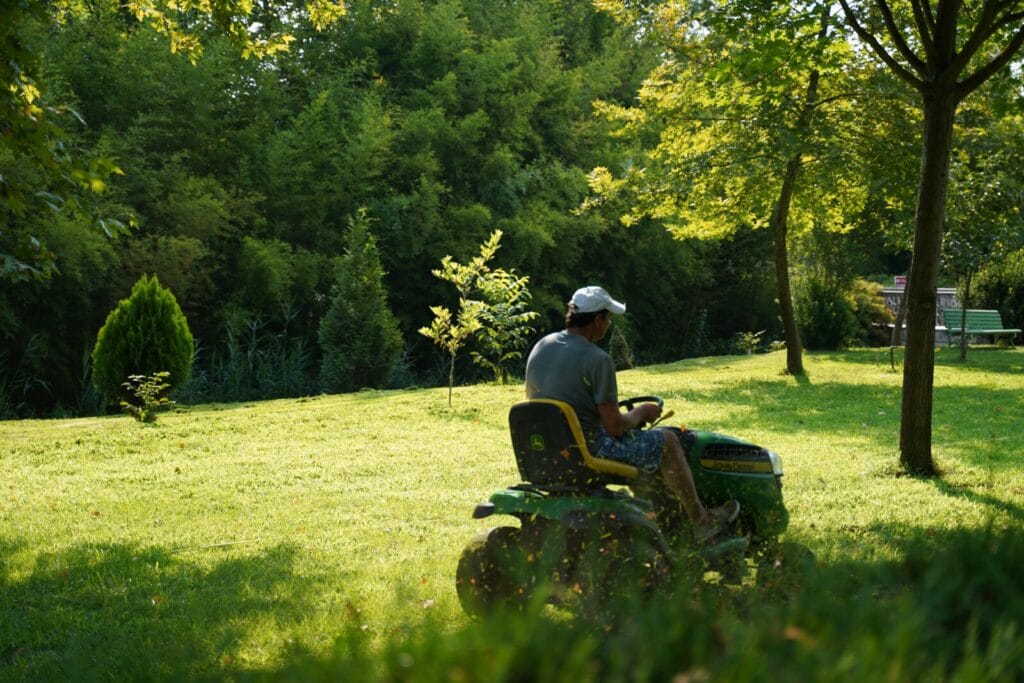
Keep the Blade Sharp
A sharp mower blade slices the grass. A dull one tears it. That sounds like a small distinction, and it is the difference between a lawn that looks healthy and one that looks off no matter what else you do.
When a dull blade beats the grass instead of cutting it, the tips fray and shred. Within a day or two those ragged tips turn brown or gray, and suddenly the whole lawn has a dull, off-color cast even though the grass underneath is fine. Worse, the torn tips lose more water through the open wounds, and the wounds themselves are entry points for fungal disease. On Davis County clay, where irrigation already creates disease pressure, that matters.
You can read your blade by looking at the lawn right after you mow. Crouch down and look at the cut tips. A clean, flat cut means the blade is sharp. Frayed, white, shredded tips mean it is dull and due for sharpening. Other signs are grass that looks torn rather than cut, the mower bogging down or needing a second pass, and extra vibration through the handle.
For most homeowners, sharpening once or twice a season keeps the blade in good shape, roughly every twenty to twenty-five hours of mowing. Sharpen sooner if you mow a big lot, and sharpen immediately after you hit a rock or a root, because a single nick changes how the blade cuts. The habit Mary Ann’s crews live by is the right one for a homeowner too: check the blade regularly rather than waiting until the lawn looks shredded. By the time the damage shows, it is already done.
Edge a Clean Vertical Line
Edging is what separates a maintained lawn from one that has merely been mowed. There are two ways to do it, and only one of them is right.
Line edging cuts a clean, vertical line straight down where the lawn meets a sidewalk, driveway, curb, or planting bed, like a knife cut into the turf. Angle edging holds the tool on a slope and shaves the edge of the grass at a bevel. We cut the clean vertical line every time, and the reason is practical, not just cosmetic. A vertical cut gives a crisp, defined border that holds its shape and resists grass creeping over the concrete. A beveled cut scalps the outside edge of the turf, which exposes soil for weeds to move into, looks soft and undefined, and needs redoing far more often. Angle edging creates the exact weed problem along the driveway that good edging is supposed to prevent.
You can cut a proper vertical edge with either of two tools. A dedicated blade edger uses a vertical steel blade and a guide wheel to cut a deep, crisp line, and it is the best tool for long straight runs along pavement. A string trimmer does the same job well when you turn it vertical, so the string spins in a vertical plane along the edge of the concrete. Most homeowners already own a trimmer, and turned the right way it produces a clean line. Either tool is correct. What matters is keeping the cut vertical, working slowly, and letting the edge of the pavement act as your guide so the line stays straight.
Edging is not the same as trimming. Trimming is cleanup, knocking down the grass the mower cannot reach around trees, posts, and fences. Edging is creating that defined boundary where the lawn meets a hard surface. A string trimmer can do both jobs, but they are different jobs. Edge often enough to keep the line crisp, which for most lawns means every mow or every other mow through the growing season.
Water Deep, Not Often
The most common watering mistake we see in Davis County is short, frequent watering, a few minutes every morning. It feels responsible. It trains the lawn to fail. Light daily sprinkles wet only the top inch of soil, so the roots stay shallow and lazy near the surface, the lawn wilts the moment it gets stressed, and the constantly damp surface invites weeds and disease while losing water to evaporation.
The right approach is what Mary Ann calls wet and soak: water deeply, and do it less often. Soaking the soil deep and then letting it dry between waterings pulls the roots downward chasing the moisture, which builds the deep, resilient root system that carries a lawn through Utah heat. Deep and infrequent watering builds a strong lawn. Shallow and frequent watering builds a weak, weedy one. It really is that direct.
Davis County adds a wrinkle: our alkaline clay soil absorbs water slowly, much slower than most sprinklers put it out. Run a single long cycle and the water pools and runs off down the driveway and into the gutter before it ever soaks down to the roots. That is wasted water and a dry lawn at the same time. The fix is cycle and soak. Split the total run time for each zone into two or three shorter cycles with a soak break in between, so each cycle’s water has time to absorb before the next one starts. The first cycle breaks the surface, and the later cycles push the water down deep with no runoff.
Water early in the morning, before the heat and wind of the day. Morning watering loses the least to evaporation and lets the blades dry as the sun comes up, which sharply cuts the fungal disease that comes from grass sitting wet overnight. Avoid watering in the heat of the day, and avoid evening watering that leaves the lawn damp into the night.
As a general guideline, Kentucky bluegrass uses somewhere around an inch to an inch and a half of water per week, more in peak summer. Treat that as a starting point rather than a fixed rule. Utah is a dry state with ongoing watering restrictions, so check your city’s current rules and adjust with the weather. To find out how long to actually run each zone, set a few straight-sided cans out on the lawn, run the sprinklers for fifteen minutes, and measure how much water collects. That tells you your sprinklers’ output, reveals dry spots, and tells you how to split your cycle-and-soak run times.
Four Habits That Build One Good Lawn
These are not four separate chores. They are one system, and they compound. Mowing tall builds deep roots and shades out weeds. A sharp blade keeps that tall grass healthy instead of frayed and disease-prone. Deep cycle-and-soak watering drives the roots deeper still and makes the lawn drought-tough. Clean vertical edging frames the whole thing so it reads as cared for. Do all four and a thick, dense, deep-rooted lawn crowds out weeds, shrugs off heat, and uses water efficiently. Skip one, scalp the grass or water it shallow, and you start fighting the other three.
The best part is that a homeowner can do every bit of this. None of it requires hiring anyone. It requires consistency and the right technique, and now you have both.
Where we come in is the work that benefits most from professional timing and equipment: fertilization matched to Utah’s alkaline clay, weed and disease control, and aeration to open up compacted soil so water and roots can get deeper. If you would rather hand those off, you can look at our individual lawn care services or the Full Season Lawn Program that phases everything across the year. And if your lawn is thinning despite good mowing and watering, the bottleneck is often compacted clay, which is exactly what core aeration is built to fix.