
Broadleaf weeds do not push healthy grass out of a lawn. They move into the spaces the grass has already given up. Every dandelion, every clover patch, every mat of spurge along the driveway is growing in a spot where the turf was too thin, too short, too dry, or too starved to hold its ground.
That distinction matters because it changes how you think about the problem. Killing the weed is the short-term fix. Closing the gap so the next weed seed has nowhere to land is the long-term one. Both matter, but if you only do the first, you will be doing it again next year.
Here are the broadleaf weeds Davis County homeowners deal with most often, how to tell them apart, and when treatment actually works.
The Weeds You Are Most Likely to Find
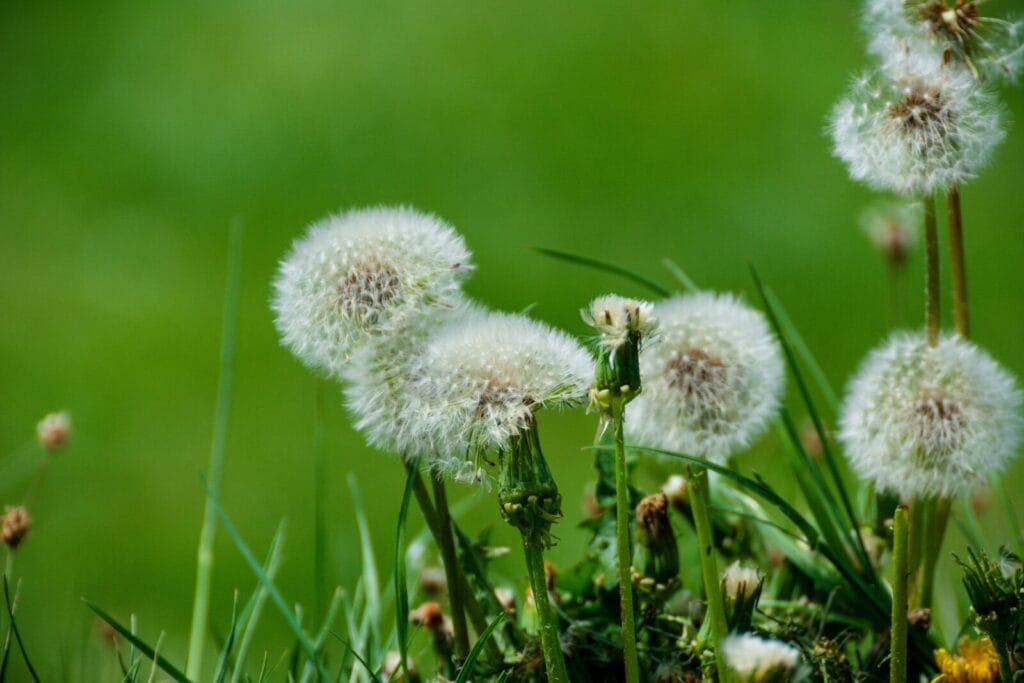
Dandelions are the ones everyone recognizes. Yellow flowers, puffball seed heads, deep taproot. A single dandelion produces roughly 15,000 wind-dispersed seeds per season, and the taproot can reach over a foot deep. Break the root while pulling and the bottom half resprouts. Dandelions thrive in thin turf and are your best indicator that the grass above them has gotten weak.
White clover is the low-growing, three-leaflet plant with small white flower clusters. It is a legume that fixes its own nitrogen from the air, which is why it shows up in under-fertilized lawns. Before selective herbicides existed, clover was actually a standard ingredient in lawn seed mixes. Many older Davis County lawns still carry it from the original planting. Some homeowners want it for the pollinator benefit and drought tolerance. Others want it gone. Either way, a lawn full of clover is telling you the nitrogen is too low.
Broadleaf plantain forms a flat rosette of tough oval leaves with prominent parallel veins. It sends up a narrow seed spike in summer. Plantain is the textbook indicator for compacted soil. If you see it in the strip between the sidewalk and the lawn, in the path where everyone cuts across the yard, or in a lawn that has not been aerated in years, the real problem is compaction, not the weed.
Common mallow has round, shallow-lobed leaves and a button-shaped fruit that looks like a tiny wheel of cheese. It develops a thick taproot fast, which makes pulling mature plants nearly impossible without a tool. Mallow tolerates low mowing and colonizes disturbed or newly seeded soil.
Field bindweed is the vine. White or pale-pink trumpet flowers, arrowhead-shaped leaves, twining stems that strangle anything they touch. It is listed as a noxious weed in Utah, and for good reason. The taproot can reach 10 feet deep, lateral roots spread several feet per year, and seeds remain viable in the soil for decades. There is no one-season solution for bindweed. Expect two to three full years of consistent treatment, and even then you will see flushes from the seed bank.
Black medic looks like clover but has small yellow flowers instead of white, and the center leaflet sits on a slightly longer stalk. It is a summer annual that fixes its own nitrogen, same as clover, and it shows up in lawns that are low on nitrogen and dry around the edges.
Henbit has square stems, scalloped round leaves, and small purple flowers in early spring. It is a winter annual that germinates in fall, overwinters as a small rosette, then blooms in March and April before dying in summer heat. It fills bare spots the lawn left open the previous fall.
Purslane is the succulent one. Fleshy leaves, red juicy stems, flat mat on hot ground. It germinates in midsummer heat when the rest of the lawn is struggling and fills cracks along sidewalks and thin spots in the turf. Do not till it. Broken stem fragments root and grow new plants.
Prostrate spurge is the mat-forming summer annual with tiny leaves and milky white sap. It crawls out from driveway edges and curb strips in July. We covered spurge in detail in a separate post earlier this spring.
Puncturevine, also called goathead, is the low-growing summer annual with pairs of small leaflets and the infamous spiny seedpod that punctures bike tires and bare feet. It is a noxious weed in Utah and produces seeds that stay viable in the soil for four to seven years. Pull every plant you see before mid-July, before the seedpods harden.
How to Tell What You Are Looking At
You do not need a field guide. Four things will get you to a correct identification most of the time.
Look at the leaf shape first. Round and lobed means mallow. Oval with parallel veins means plantain. Three leaflets means clover or black medic. Arrowhead means bindweed. Tiny and matted means spurge, purslane, or puncturevine.
Then check the growth habit. A flat rosette pressed to the ground is dandelion or plantain. A low mat radiating from a center is spurge, purslane, or puncturevine. A vine climbing or trailing across the lawn is bindweed.
Flower color and timing narrow it further. Yellow puffball in spring is dandelion. White puffball cluster in summer is clover. Small yellow flowers on a clover lookalike is black medic. Purple tubes in March is henbit. White trumpets in summer is bindweed. Yellow five-petal flowers in summer heat could be purslane or puncturevine.
Finally, check whether it is annual or perennial. Annual weeds like henbit, purslane, spurge, and puncturevine come from seed every year. Kill the plant and prevent the seed and you are done. Perennial weeds like dandelion, clover, plantain, bindweed, and sometimes mallow come back from the same root every year. Kill the top growth without killing the root and you have accomplished nothing.
What You Can Do Without Calling Anyone
The most effective weed control a homeowner can do costs nothing and involves no chemicals at all. Raise the mower to 3 to 3.5 inches and keep it there all season. Taller grass shades the soil surface, cools the root zone, and physically prevents most weed seeds from getting the sunlight they need to germinate. This single change does more for weed control than any product in your garage.
Fertilize on schedule. Clover and black medic disappear from lawns that are properly fed with nitrogen. A nitrogen-deficient Kentucky bluegrass lawn is an open invitation for legume weeds.
Water deeply and infrequently. Two or three deep waterings per week beat daily shallow runs. Deep watering pushes grass roots down and dries the surface between cycles, which starves shallow-rooted weed seedlings.
Core aerate at least once a year, ideally in fall. Compacted soil is what plantain and mallow love. Breaking up the clay with aeration improves root growth, water infiltration, and turf density all at once.
Hand-pulling works for dandelions and plantain if you do it when the soil is wet and you get the entire taproot. Use a narrow dandelion fork and push it down at least six inches before prying. If you snap the root, the bottom half resprouts.
For spot treatment, use a selective broadleaf herbicide containing 2,4-D, dicamba, and MCPP. This is the standard three-way mix sold under several brand names at any hardware store. Spray the weed, not the whole lawn. Apply when air temperatures are between 60 and 85 degrees, the weed is actively growing, and no rain is expected for 24 hours.
Never use glyphosate on the lawn. Glyphosate is non-selective. It kills any green plant it touches, grass included. Save it for cracks in the driveway, gravel strips, and fence lines where there is nothing you want to keep.
One more thing: do not spray broadleaf herbicide on newly seeded areas until the new grass has been mowed at least three or four times. The same chemistry that kills dandelions will kill grass seedlings.
Why Fall Is the Treatment That Matters Most
Spring broadleaf control works. It kills the top growth and knocks weeds back for the season. But if you could only treat once a year, fall is the application that changes the lawn.
Here is why. When nights cool down in September, perennial weeds reverse the direction of sugar flow in their stems. All season they have been pushing energy up from the roots to feed leaves and flowers. In fall, they pull that energy back down to store in the roots for winter. A selective herbicide applied during that window rides the sugar stream all the way to the root and kills the plant from the inside. Spring applications burn the leaves. Fall applications destroy the root system.
The practical difference is significant. A single well-timed fall application controls perennial broadleaf weeds at a far higher rate than a spring or summer treatment. A spring spray on dandelions often just scorches the rosette, and the taproot pushes new leaves within weeks. A fall spray on the same dandelion kills the taproot while it is pulling energy down, and the plant does not come back the following spring.
We build our weed control program around this biology. Broadleaf treatment is phased across the season, with the fall visit weighted as the most important application of the year for perennial weeds. Spring handles early escapes and winter annuals. Summer handles spurge and other heat-season annuals that only exist during the warm months. But fall is where the real work gets done on the dandelions, clover, plantain, and bindweed that come back year after year.
For bindweed specifically, we set expectations honestly: two to three full seasons of consistent fall-weighted treatment, paired with the thickest turf you can grow over the top of it, is what actually moves the needle. One season will suppress it. Two seasons will thin it. Three seasons, combined with a dense lawn that shades the soil, is what turns it from a losing battle into a manageable situation.
The bigger picture is that weed control and turf health are not separate problems. They are the same problem. A lawn that gets proper fertilization, aeration, and mowing height does not give weeds a foothold. A lawn that is thin, starved, and scalped gives them the whole yard. Our Full Season Lawn Program is built around that idea: five visits from March through October that keep the turf thick enough to do most of the weed prevention on its own, with targeted broadleaf control at each visit to handle what gets through.
If you want to see what we offer for weed-specific help or the full treatment program, our lawn care services page covers everything.