
Mushrooms showing up in a Davis County lawn alarm most homeowners. They look like something is wrong. In the vast majority of cases, nothing is. The mushrooms are actually doing useful work, and the lawn is fine.
A mushroom is not the organism. It is the fruiting body of a fungus living underground. The real fungus is a network of thin white threads called mycelium running through the soil, quietly feeding on dead organic matter. When moisture and temperature line up, the fungus pushes mushrooms to the surface to release spores. That is the only reason you see them. They are not attacking your grass. They are breaking down buried wood, old roots, and thick thatch, and returning nutrients to the soil in the process.
The question is not whether lawn mushrooms are normal. They are. The question is whether yours are the harmless kind or the one type that actually damages turf. That distinction changes everything about how you respond.
What Mushrooms Are Feeding On
The underground fungus producing those mushrooms is almost always eating one of four things.
Buried wood is the most common source in newer Davis County subdivisions. During construction grading, builders routinely push tree stumps, roots, old fence posts, and scrap lumber under the surface. Years later, as that material decomposes, mushrooms appear in the lawn. Sometimes they pop up in surprisingly precise circles or arcs that mark the outline of an old root system underground. If your home is less than fifteen years old and mushroom circles appeared out of nowhere, buried construction debris is the most likely explanation.
Old tree roots are the second source. A stump grinder removes the visible wood but leaves the root system intact below grade. Those roots can feed mushrooms for five to ten years as they slowly break down.
Thick thatch is the third. The layer of dead grass stems and roots between the green blades and the soil surface becomes fungal food when it gets thicker than about half an inch. On Davis County clay, where water sits near the surface and thatch stays damp, this is common on lawns that have not been aerated in a few years.
Decomposing mulch and old leaf material make up the fourth. Wood chip beds adjacent to the lawn, or leaves that were tilled into the soil during landscaping, provide a food source the fungus can work on for years.
In every case, the fungus is a decomposer. It is breaking down material that would otherwise sit in the soil unchanged. That process releases nitrogen and other nutrients the grass can use. A lawn with occasional mushrooms after rain has biologically active soil, which is a good sign, not a bad one.
How to Tell If It Is Just Cosmetic or Actually Fairy Ring
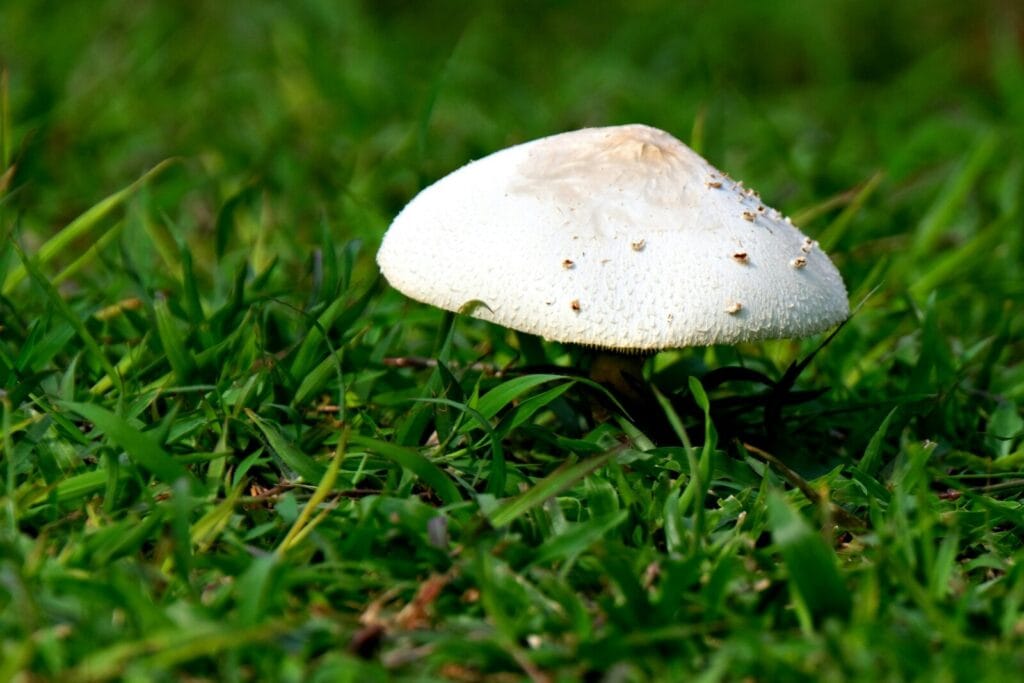
Most lawn mushrooms are scattered, random, and show up after heavy watering or rain. They last a day or two, then disappear when the soil dries out. Puffballs, inky caps, and field mushrooms all fall into this category. They are cosmetic nuisances. Kick them over, mow them off, or pick them up and throw them away. The underground fungus will keep working regardless, but the visible mushrooms are gone.
Fairy ring is different. Fairy ring is a specific pattern where mushrooms, dark green grass, or dead grass appears in a circular or arc-shaped formation that gets larger every year. The fungus colony grows outward from a central point at roughly four to eight inches per year, and the ring expands with it.
There are three types, and only one is a real problem.
Type 3 is the most common in home lawns: a ring or arc of mushrooms with no visible effect on the grass. The lawn looks normal except for the mushrooms along the ring. This is cosmetic. Mow the mushrooms off and move on.
Type 2 is a ring of darker green, faster-growing grass with no dead zone. The fungus is releasing nitrogen as it decomposes organic matter, and the grass directly above the active mycelium grows greener than the surrounding lawn. This is also cosmetic. Fertilizing the rest of the lawn evens out the color.
Type 1 is the one that matters. A band of dead or dying grass appears in a ring or arc, sometimes flanked by a band of dark green growth on one or both sides. What is happening underground is that the fungal mycelium has created a hydrophobic zone in the root zone. The soil in that band repels water. Rain and irrigation sheet off or run sideways instead of soaking in. The grass dies of drought even when the rest of the lawn is well watered.
Type 1 fairy ring is most damaging in summer heat, when the water-repellent soil dries out completely and the grass in the ring cannot recover on its own. If you pour water directly onto the dead band and it beads up and rolls off instead of soaking in, you are looking at Type 1.
What You Can Do About Lawn Mushrooms
For ordinary mushrooms that are not forming fairy rings, the fix is almost always a watering adjustment.
The single biggest controllable cause of persistent lawn mushrooms in Davis County is overwatering. Daily shallow irrigation keeps the soil surface damp, which is exactly what fungi need to produce fruiting bodies. Switching to deeper, less frequent watering, two to three times per week instead of every day, lets the surface dry between cycles and dramatically reduces mushroom activity. Water in the morning so the surface dries during the day. Evening watering keeps the soil damp overnight, which is when fungi are most active.
Improve drainage in low spots where water pools after rain or irrigation. Mushrooms cluster in those areas because the soil stays saturated longer.
Core aeration helps on multiple fronts. It breaks up compacted clay, improves water penetration and air movement, and reduces the thatch layer that feeds surface fungi. Annual aeration on Davis County clay is good practice for the lawn overall, and fewer mushrooms are a side benefit.
Pick mushrooms and bag them if they bother you or if you have children or pets in the yard. Removing them does not kill the underground mycelium, but it stops spore release and eliminates the visual nuisance. Do not eat any lawn mushrooms. Several common yard species have toxic lookalikes that are difficult to distinguish without expert knowledge. The green-spored parasol, which often appears in lawn fairy rings, is one of the most common causes of mushroom poisoning in the country.
For Type 1 fairy ring with a dead grass band, the cultural approach is specific. Core aerate through the dead band, punching as deep as your equipment allows, to physically break the hydrophobic layer. Apply a wetting agent to the aerated area to help water penetrate soil that is repelling it. Then soak the area heavily, enough to saturate the soil to at least a foot, and repeat weekly for four to six weeks. Reseed bare spots once the soil is accepting water again.
One thing that does not work: spraying a general fungicide on lawn mushrooms. The fungus lives deep in the soil, feeding on material that surface applications cannot reach. No product sold at a garden center will stop lawn mushrooms in any meaningful way. Anyone selling a mushroom-killing spray for general lawn mushrooms is selling something that does not solve the problem.
When Mushrooms Cross the Line Into a Real Problem
Most of the time, mushrooms in a Davis County lawn do not need professional treatment. Fix the watering schedule, aerate the soil, and the mushrooms go away on their own when conditions dry out. We tell homeowners that plainly because it is true.
The exception is Type 1 fairy ring with dead grass bands that keep expanding. That hydrophobic soil zone is genuinely difficult to break, and the combination of deep core aeration, commercial wetting agent, and high-volume soil drenching is more reliably done with professional equipment than with a garden hose and a rental aerator. If you have tried the cultural approach for a full season and the ring keeps growing, that is when it makes sense to call.
The other situation worth a call is when mushrooms appear alongside other lawn symptoms that do not fit the fairy ring pattern, things like irregular brown patches, ring-shaped dead areas without mushrooms, or discolored circles that seem to expand in summer heat. Those could indicate a turf disease like necrotic ring spot or summer patch, which requires a completely different diagnosis and treatment. Our fungus control service is built to sort out what is actually happening and treat accordingly.
If your soil is heavily compacted and you have not aerated in a few years, core aeration addresses the drainage and thatch conditions that keep mushroom pressure high. And our broader lawn care services page covers everything we offer for Davis County lawns, from fertilization to weed control to disease management.
We have been working on Davis County lawns since 1981, from Kaysville to Farmington to Centerville. If you are not sure whether your mushrooms are cosmetic or something worse, send us a photo. We will tell you straight whether it needs treatment or whether it will go away on its own when the soil dries out.
Are lawn mushrooms dangerous to kids or pets?
Most are just a cosmetic nuisance you can pick up and bag. But never eat lawn mushrooms. Several common yard species, including the green-spored parasol that often appears in fairy rings, have toxic lookalikes and are a leading cause of mushroom poisoning.
Do mushrooms mean something is wrong with my lawn?
Usually the opposite. Mushrooms are the fruiting body of a fungus decomposing buried wood, old roots, or thatch and releasing nutrients back into the soil. Occasional mushrooms after rain are a sign of biologically active soil, not a problem.
What is the difference between ordinary mushrooms and fairy ring?
Ordinary mushrooms are scattered and random, disappearing within a day or two once the soil dries. Fairy ring grows in a circular or arc pattern that gets larger every year, and only Type 1, a band of dead or dying grass, actually damages turf. The other types are cosmetic.
Why do mushrooms keep coming back in the same spot?
The biggest controllable cause is overwatering. Daily shallow irrigation keeps the soil surface damp, which is exactly what fungi need to fruit. Switching to deeper, less frequent watering, two to three times a week instead of daily, dramatically reduces mushroom activity.