
Why does spurge keep showing up in your lawn every summer even though you pulled every plant last year? The answer is seeds. A single spotted spurge plant can produce several thousand seeds in one growing season, and UC IPM reports it can start producing those seeds as soon as five weeks after germination. By the time most homeowners notice the flat, spreading mats in July, the plant has already seeded the soil for next year.
Spurge is a summer annual weed that arrives in Davis County lawns later than crabgrass, thrives in the hottest months, and is significantly harder to kill once it matures. The window to stop it is right now in mid-April, weeks before it germinates. This guide covers what spurge is, how to spot it, what cultural steps keep it out, and how we handle it on professional programs.
What Spurge Is and Why It Matters in Davis County
Spotted spurge is a summer annual in the Euphorbia family. It germinates from seed each spring, grows through summer, and dies with the first hard frost. USU Extension’s spotted spurge fact sheet places germination between 60 and 100 degrees soil temperature, with peak germination in mid-to-late summer. That is significantly warmer than the 55-degree threshold for crabgrass.
This temperature gap is the reason many homeowners who applied pre-emergent in early April still end up with spurge in July. A single early-spring application timed for crabgrass can be running out of residual just as spurge seeds are waking up. The two weeds need different timing, even though they are often grouped together on product labels.
Spurge exploits three conditions that nearly every Davis County lawn has somewhere: thin turf where grass is sparse, compacted soil along sidewalks and driveways, and heat-stressed areas where Kentucky bluegrass goes semi-dormant in August. The weed grows as a flat mat radiating from a central taproot, staying at or just below mowing height. Mowing does not touch it. Watering does not discourage it. It fills every gap the lawn leaves open.
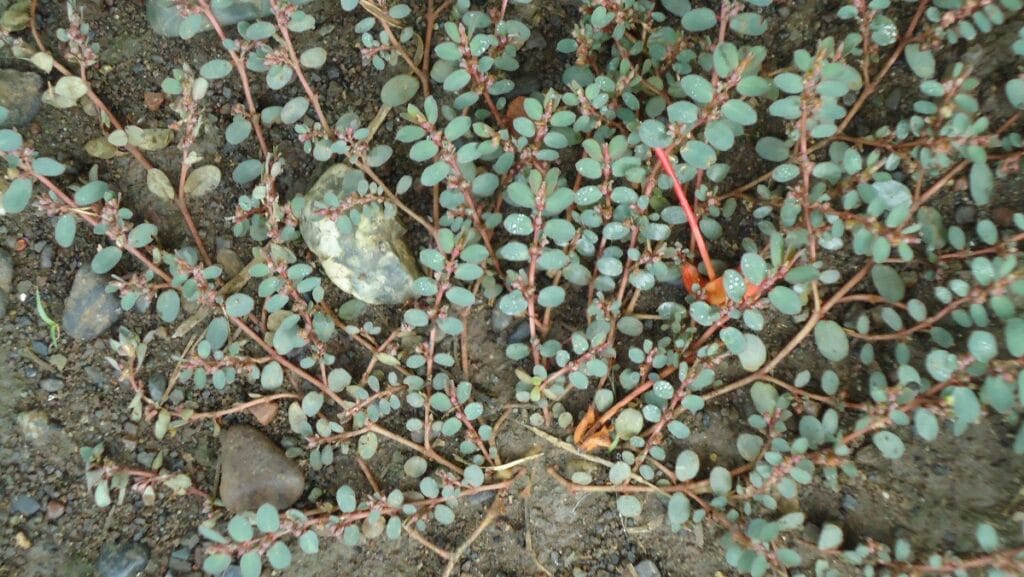
How to Identify Spurge in Your Lawn
Three features together make spurge unmistakable.
The first is the growth habit. Spurge grows flat against the ground in a circular mat with stems radiating from a central point. Penn State Extension describes it as prostrate, mat-forming, with stems that can spread up to two feet in diameter by late summer. The plant rarely rises more than an inch off the soil surface.
The second is the leaves. Small, oval, arranged in opposite pairs along the stem. Most spotted spurge leaves have an irregular maroon or purple blotch near the center. That blotch is what gives “spotted” spurge its name. Prostrate spurge, a closely related species, often lacks the spot. Penn State notes the two are similar enough that some botanists consider them the same species. For identification and control purposes, treat them the same.
The third is the milky sap. Break a stem and a thick white latex oozes out within seconds. This is diagnostic. USU Extension confirms that spurge stems exude a thick milky substance when snapped. No other common Utah lawn weed with a similar flat growth habit produces milky sap. Prostrate knotweed, common purslane, and puncturevine are the three weeds most often confused with spurge, and none of them bleed white.
The sap is a mild skin irritant. Wear gloves when handling spurge, and keep it away from your eyes.
As of mid-April, spurge has not germinated yet in Davis County. Soil temperatures are still too cool. The first small green rosettes typically appear in late May or early June. By mid-July those rosettes are the size of a saucer. By August they are dinner plates. The earlier you catch them, the easier they are to deal with.
What Homeowners Can Do
The most effective thing a homeowner can do about spurge has nothing to do with herbicide. It is keeping the lawn thick enough that spurge cannot get a foothold.
Mow at 2.5 to 3 inches. Taller grass shades the soil surface and drops the temperature at ground level. Spurge seeds need light and warmth to germinate. UC IPM notes that seeds buried deeper than half an inch germinate poorly. A dense canopy of Kentucky bluegrass at the right height denies them both light and surface warmth.
Water deeply and less often. Frequent shallow watering keeps the top half inch of soil warm and moist, which is exactly what spurge seeds need. Two deep waterings per week during summer encourages grass roots to grow deep while drying out the soil surface between cycles.
Address thin spots and compacted areas. Spurge is a symptom of weak turf. The weed fills gaps. Overseeding thin areas in September, paired with core aeration to break up compacted soil, removes the conditions spurge needs. Edges along sidewalks and driveways are the most common entry points because concrete reflects heat and turf thins along hard surfaces.
Hand-pulling works if you catch it early. Spurge has a shallow taproot that comes out easily from moist soil. Two rules: pull before the plant flowers (roughly five weeks after germination, so June or early July for Davis County), and get the whole crown. Stems that break at the base leave the crown intact and the plant resprouts. Bag pulled plants rather than composting them to keep seeds out of the soil.
What does not work: mowing (spurge grows below the blade), pulling after seed set (you are just scattering seeds), and a single early-April pre-emergent without a follow-up for spurge timing.
How We Keep Spurge Out of Davis County Lawns
The gap between crabgrass timing and spurge timing is where most DIY weed programs fall apart. Our approach is built around closing that gap with a split pre-emergent schedule.
Our first application goes down in March or early April, timed to crabgrass germination. That handles the first wave of summer annuals. For lawns with spurge history, we follow up with a second pre-emergent application in late May or early June, timed specifically to the warmer soil temperatures that trigger spurge. USU’s own gardening almanac recommends this second application for annual weeds like crabgrass and spurge, and it is standard practice on any Davis County lawn where spurge has shown up in prior years.
When spurge does break through on lawns with a heavy seed bank, we treat early. Selective broadleaf herbicides work well on young spurge plants with just a few stems radiating from the center. They work poorly on mature mats. The window between first sighting and first flowering is roughly three to five weeks, and we schedule treatments inside that window rather than waiting for the plant to spread.
Temperature matters for post-emergent applications too. Broadleaf herbicide formulations can volatilize above 85 degrees and lose effectiveness while risking drift onto nearby ornamentals. We schedule treatments around morning weather windows, not around the calendar.
The deeper fix is turf density. We have been building lawn programs in Centerville, Fruit Heights, and West Bountiful since 1981, and the lawns that stay clean of spurge year after year are the ones where the grass is thick enough to shade the soil by June. Our weed control service handles the herbicide side. Our pre-emergent service handles the prevention timing. The Full Season Lawn Program ties fertilization, weed control, and pre-emergent into one schedule built around how Davis County weeds actually behave, not a national calendar.