
If your tree has yellow leaves with green veins, your first instinct is probably to add iron. That instinct is wrong, and it is why most homeowners end up wasting money on garden-center products that do nothing.
Davis County soil is not low in iron. Iron is the fourth most abundant element in Earth’s crust, and there is plenty of it in the ground under your yard. The problem is not how much iron is in the soil. The problem is that the soil chemistry converts it to a form your tree’s roots cannot absorb. Until you understand why, every product you buy will disappoint you.
Iron chlorosis is the most common tree problem we diagnose in Davis County. It affects silver maples, red maples, pin oaks, aspens, and river birches across every neighborhood from Bountiful to Layton. Here is how to recognize it, which trees are at risk, why most treatments fail, and what actually works.
How to Spot Iron Chlorosis on Your Trees
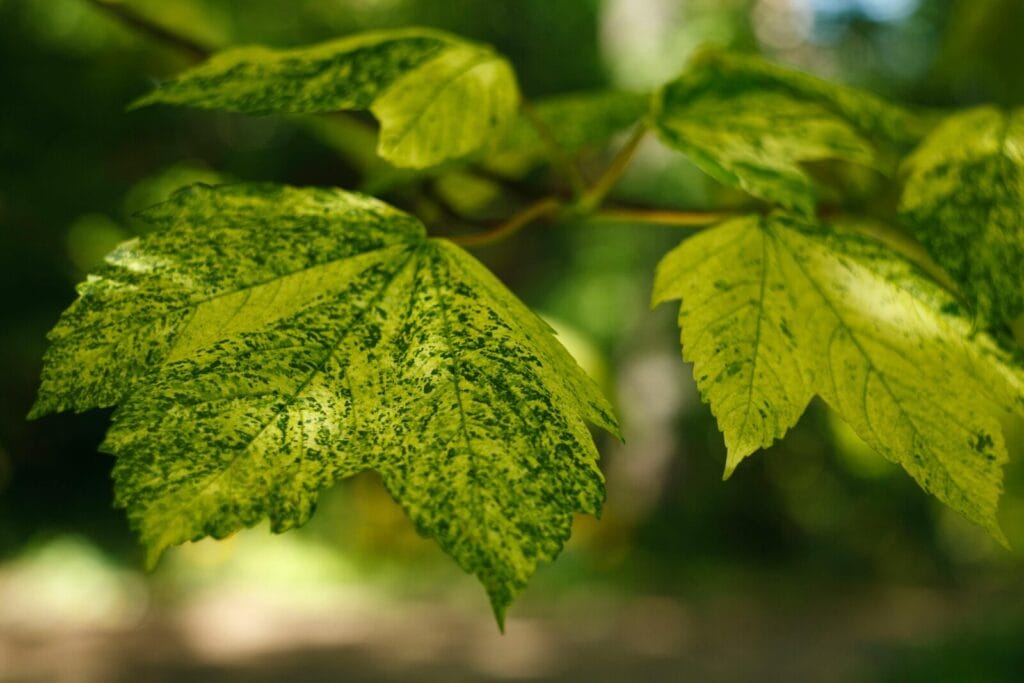
The signature is specific and easy to read once you know what to look for. The tissue between the leaf veins turns yellow or pale green while the veins themselves stay darker green. That contrast between vein color and leaf color is the fingerprint. On a healthy leaf, the green is uniform from edge to vein. On a chlorotic leaf, the veins look like a green skeleton floating in a yellow background.
Two details confirm it is iron and not something else. First, new growth is affected first and worst. Iron is immobile in plants. Once the tree pulls iron into a mature leaf, that iron stays locked there and cannot be moved to feed the next leaf. When iron uptake from the soil drops, the brand-new leaves at the branch tips show the deficiency first while older leaves deeper in the canopy may still look normal. If the yellowing starts on the oldest leaves and works outward, you are looking at nitrogen deficiency, not iron.
Second, symptoms show up in spring and are easiest to read through June. Mid-May through late June is the cleanest diagnostic window because new leaves are fully expanded and the contrast is sharpest. By mid-July, heat stress, drought, and spider mites start complicating the picture.
The progression matters because it tells you how urgent the problem is. Mild chlorosis is slightly pale leaves with a visible green-vein pattern. The tree looks off but is still functional. Moderate chlorosis is uniform lemon-yellow or nearly white leaves. Severe chlorosis adds brown, scorched leaf margins, premature leaf drop in summer, and twig dieback over winter. Advanced chlorosis kills entire scaffold limbs and thins the canopy from the top down. That progression usually takes three to seven years on a mature shade tree, but it only goes in one direction unless you intervene.
Why Davis County Soil Locks Out Iron
The chemistry is simple. Soil pH controls the form iron takes. Below pH 7.0, iron exists in soluble forms that roots can absorb. Above pH 7.0, iron rapidly converts to insoluble compounds that are chemically stable, do not dissolve back into the soil water, and cannot be transported through root membranes. The iron is physically touching the roots. The tree cannot use it.
Wasatch Front soils commonly run pH 7.5 to 8.5. At pH 8.0, which is typical for Bountiful, Centerville, Farmington, Kaysville, and Layton yards, iron availability is so low that susceptible trees cannot pull enough out of the soil to make chlorophyll.
The natural follow-up question is why you cannot just add sulfur and lower the pH. The answer is lime. Davis County soils formed on ancient Lake Bonneville sediments and contain anywhere from 15 to 40 percent calcium carbonate by weight. That lime gives the soil enormous buffering capacity. Add sulfur to the surface and the lime neutralizes the acid before it can move the pH in any lasting way. You might lower the top inch of soil for a few weeks. Below that, nothing changes. The amount of sulfur needed to meaningfully lower pH in a calcareous Davis County soil is physically impractical and would damage the lawn, the irrigation system, and likely the tree.
The soil chemistry is what it is. You cannot fight it. You have to work with it.
Which Trees Get It and Which Do Not
After working on Davis County trees for over four decades, from Bountiful to Centerville to Kaysville and every city in between, the pattern is consistent. Some species handle alkaline soil. Some do not.
Silver maple is the worst offender. It was planted in Davis County subdivisions from the 1970s through the 1990s because it grew fast and cheap. The mature ones are now showing chronic chlorosis on a massive scale. If you have a 30-year-old maple with a pale yellow canopy, this is almost certainly the problem.
Red maple, including the popular Autumn Blaze and October Glory cultivars, is the next most common. Autumn Blaze is a hybrid that inherits chlorosis susceptibility from both parents. These were the replacement trees of choice in Davis County developments built in the 2000s and 2010s. They look fine for the first few years while they grow on the nursery soil that came with the root ball. Then their roots reach the native soil and the leaves start turning yellow. We are seeing this wave hit right now across newer Layton, Kaysville, and Syracuse neighborhoods.
Pin oak develops chlorosis almost every time it is planted in Utah soil. Quaking aspen, despite being native to Utah, is adapted to cool, slightly acidic mountain soils, not the pH 8 lake-bottom clay at valley elevation. River birch is marketed as alkaline-tolerant but does not hold up in Davis County’s soil chemistry.
On the other side, honeylocust, most elms, hackberry, Kentucky coffeetree, and ginkgo rarely show chlorosis here. One note: the Sunburst honeylocust cultivar has bright yellow new growth by genetic design. That is not chlorosis. The leaves are supposed to look that way.
Why the Iron You Bought at the Garden Center Did Not Work
This is where most homeowners get stuck. They see the yellow leaves, search online, buy a bag of “chelated iron” at the hardware store, apply it, and watch nothing happen. Then they conclude iron does not work.
The iron works. The chelate was wrong for the soil.
A chelate is a molecule that wraps around the iron atom and protects it from converting to the insoluble form in alkaline soil. Different chelates protect iron at different pH ranges, and the difference between them is not subtle.
EDTA-chelated iron holds iron in solution up to about pH 6.0. By pH 7.0, virtually none of the iron is available. In Davis County soil at pH 8, EDTA iron is useless from the moment it hits the ground.
DTPA-chelated iron works up to about pH 7.0 to 7.5. At pH 8.0, roughly 60 percent of the iron has already precipitated out. Most garden-center “chelated iron” products are DTPA-based. The label rarely tells you which chelate is in the bag.
FeEDDHA is the only chelate that remains stable and plant-available above pH 7.5. It stays intact across the full pH range found in Davis County soil, including the pH 8.0 to 8.5 conditions that destroy the other two. It also costs significantly more per unit of iron, which is why garden-center products almost never use it.
If you take one thing from this post: in Davis County soil, only EDDHA-chelated iron stays available to roots. If the label does not specifically say EDDHA, it will likely disappoint at our pH. Check before you buy.
Iron sulfate, the cheap product labeled “ferrous sulfate” or “copperas,” has the same problem. It dissolves and briefly puts soluble iron into the soil, but in calcareous soil that iron converts back to insoluble forms within hours. It also stains concrete and stucco a rust color that does not come out.
How to Know If Your Tree Needs Help
If you have a maple, oak, birch, or aspen with yellow leaves and green veins on new growth, the diagnosis is almost certainly iron chlorosis. A soil test through the USU Analytical Lab for about $25 confirms pH and tells you whether phosphorus is already high, which it usually is in Davis County. That information tells you the tree needs iron in the right form, not a balanced fertilizer.
For mild chlorosis caught early, a soil-applied FeEDDHA product can help if you can find one. Check the label for the EDDHA chelate specifically. Apply it to the soil under the drip line in spring, water it in, and give it a full growing season to show results.
For moderate to severe chlorosis, or for mature trees where you need iron delivered below the lawn root zone and into the tree’s feeder roots, deep root feeding with professional-grade FeEDDHA is the treatment that works reliably on Davis County soil. We inject the chelated iron directly into the root zone at a depth of four to eight inches, where the tree’s absorbing roots work, in a form that stays available despite the surrounding pH. Most moderately chlorotic trees show visible greening within one growing season. Severely chlorotic trees with twig dieback usually need two to three years of treatment.
Our deep root fertilizer service covers the injection technique and timing. The Tree and Shrub Program includes two deep root feedings per year, spring and fall, plus two preventative insect control treatments. Trees on the program build cumulative iron reserves and show stronger improvement in the second and third year than in the first.
If you want a tree-by-tree evaluation before committing, we do those for free. Walk the yard with our technician, point out which trees concern you, and we will tell you honestly which ones need feeding and which ones are fine. Our tree care services page covers everything we offer for Davis County trees and shrubs.
Yellow leaves are the tree telling you something is wrong. The earlier you respond, the less it costs and the faster the tree recovers.