
If you want clean apples, worm-free cherries, and peaches without shothole blight, one spray a year will not get you there. A backyard fruit tree in Davis County needs four to eight separate applications between late February and August, each one timed to a specific pest at a specific growth stage. Miss one and the pest it targeted gets a free pass for the season.
That sounds like a lot. It is. But the schedule follows the tree, not the calendar, and once you understand the stages, the logic is simple. Here is the full fruit tree spray schedule for northern Utah, from dormant season through harvest.
Stage 1: Dormant Oil and Copper (Late February Through Mid-April)
This is the foundation. Dormant oil smothers overwintering aphid eggs, scale insects, mites, and peach twig borer larvae on the bark. Copper fungicide, tank-mixed with the oil, handles peach leaf curl on peaches and nectarines, coryneum blight on stone fruit, and fire blight inoculum on apples and pears with a history of infection.
The application goes on at delayed dormant, when buds have started to swell but no green tissue is showing yet. Temperature must be above 40 degrees with no freeze expected for 24 hours. Apricots break dormancy first and need to be sprayed earliest. Apples and pears go last and have the widest window.
We covered the full science of dormant oil in a separate post earlier this year, including what it controls, what it does not control, and the bud-stage and temperature rules. If you have not read that one, start there. This post picks up where dormant oil leaves off.
The critical point for this schedule: dormant oil does not control codling moth, cherry fruit fly, or borers. Those are the pests that ruin the fruit, and they require separately timed treatments after bloom.
Stage 2: Pre-Bloom (Green Tip to Tight Cluster)
As buds push toward bloom, the schedule starts to split by species.
On peaches, nectarines, and apricots, if peach twig borer was a problem last year and you missed the delayed-dormant treatment, this is the backup window. A spinosad or Bt application as buds open targets twig borer larvae before they bore into new shoots.
On apples and pears, if apple scab or powdery mildew has been an issue, start a protectant fungicide at green tip and repeat every 7 to 14 days through petal fall. Scab is a wet-weather disease, and the Wasatch Front’s unpredictable spring rains make it a recurring problem on susceptible apple varieties.
Stage 3: Bloom (Do Not Spray)
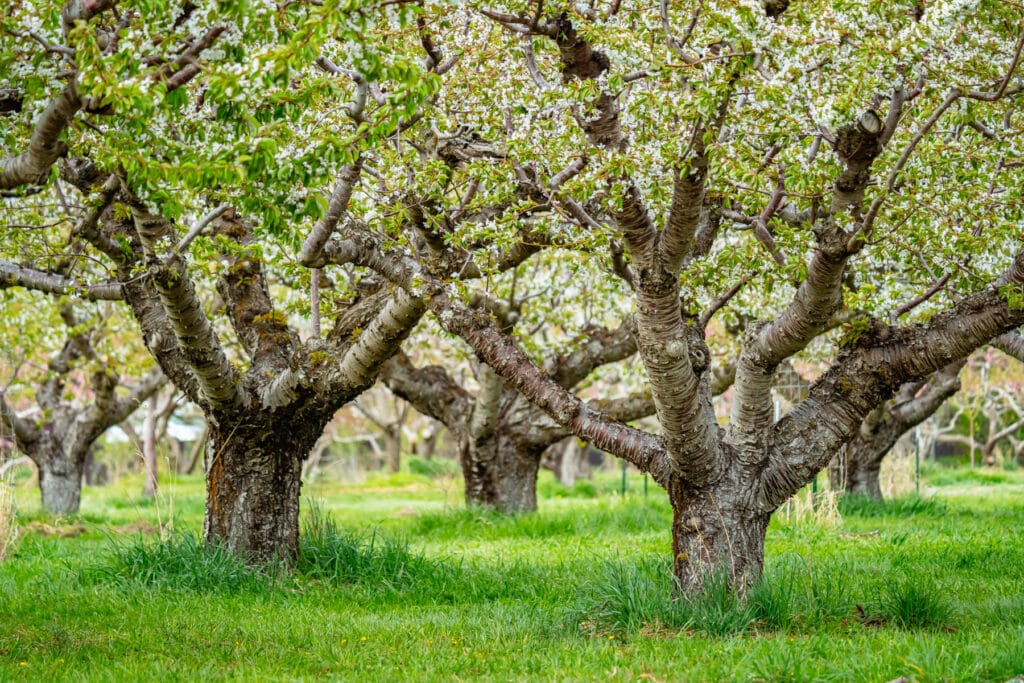
This is the most important rule in the entire schedule. Do not spray insecticide during bloom.
Open flowers are full of honey bees and native pollinators. Spraying during bloom kills them, and a tree without pollinators is a tree without fruit. This applies to every insecticide, organic or conventional. No exceptions.
If you must apply anything during bloom, only Bt for peach twig borer on stone fruit or streptomycin for a confirmed fire blight risk on apples qualifies, and both should go on at dusk after bees have returned to the hive. For most backyard growers, the right move is to do nothing during bloom and pick up the schedule again at petal fall.
Stage 4: Petal Fall and First Cover Spray
This is where the season begins in earnest. When the last petals drop from your apple or pear, set codling moth pheromone traps if you have not already. Codling moth is the single most damaging pest of backyard apples and pears in northern Utah. The larva is the “worm in the apple,” and on an untreated tree it can damage 80 to 95 percent of the fruit.
The first codling moth spray does not go on at petal fall itself. It goes on 7 to 14 days later, timed to the beginning of first-generation egg hatch. The USU IPM Pest Advisories publish Davis County spray dates every spring based on degree-day models. For 2026, the published “Apply First Spray” dates are May 7 for Bountiful, May 10 for Kaysville, and May 10 for Layton.
For conventional insecticides, one application provides about 14 days of protection. Repeat once, 14 to 21 days later, to cover the full first-generation egg-hatch window. For organic options like spinosad, residual is shorter and you spray every 7 to 10 days.
On stone fruit, the petal fall window is when a shuck-split fungicide goes down to target brown rot and coryneum blight on peaches, nectarines, and apricots.
Stage 5: Summer Cover Sprays (Mid-May Through August)
This is the long stretch, and the schedule splits by species.
On apples and pears, codling moth has two generations in northern Utah and sometimes a partial third. The second generation begins egg-laying in early July and continues into August. You stay on a 10 to 14 day spray interval through the egg-hatch windows, rotating insecticide chemistry between generations to avoid resistance. Most homeowners who stop spraying after the first round in May end up with wormy fruit by harvest.
On cherries, western cherry fruit fly is the pest to watch. Adults emerge in late May to early June, and the trigger to spray is the fruit itself, not a calendar date. When cherries in the sunniest part of the tree turn a salmon-blush color, the spray window opens. Repeat every 7 to 10 days until harvest.
On peaches and nectarines, peach twig borer has multiple generations through the summer. The first generation attacks new shoots. Later generations feed inside the developing fruit. Brown rot fungicide applications resume in the three to four weeks before harvest because brown rot is the disease that turns a ripening peach into mush overnight.
Across all species, spider mites can flare during hot, dry stretches in July and August. Stippled leaves and fine webbing on the undersides of leaves are the signs. A summer-rate oil at 1 percent or a miticide knocks them down.
Stage 6: Pre-Harvest and Fall Cleanup
Every insecticide and fungicide has a pre-harvest interval printed on the label, the number of days between the last spray and when you can pick the fruit. Those intervals range from 1 to 14 days for most backyard products. Read the label. Stop spraying when the PHI says to stop.
After harvest, two cleanup steps make next year easier. Rake and remove all fallen fruit and leaves under the tree. Dropped apples harbor codling moth larvae that pupate over winter. Fallen peach leaves carry brown rot and coryneum spores into the next season. This one sanitation step does more for next year’s pest pressure than any spray you can buy.
On peaches, apricots, and plums, a copper application at about 50 percent leaf drop in fall reduces coryneum blight carryover into next spring’s dormant window.
Why Most Backyard Trees Never Get Sprayed Right
The homeowner who calls in August wondering why every apple has a worm missed the May 10 codling moth spray. The homeowner whose cherries are full of maggots never watched for salmon blush. The homeowner with curled, blistered peach leaves missed the copper application in March.
The pattern is the same every year. It is not that the products are complicated or the schedule is secret. It is that the schedule demands four to eight precisely timed applications across six months, each one tied to a growth stage or a pest emergence date, with weather and pollinator rules attached.
For one or two small dwarf trees, a homeowner with a pump sprayer and a calendar can handle this. The people who succeed watch the tree instead of the calendar, spray at dusk to protect bees, and keep records. For mature trees over 15 feet, the math changes. Getting good spray coverage into the upper canopy of a tall apple or cherry requires commercial equipment that delivers volume and pressure a backyard sprayer cannot match.
We have been spraying fruit trees in Davis County since 1981. Kaysville and Fruit Heights were orchard country before they were suburbs, and a lot of homes in those neighborhoods came with mature trees the current owner did not plant. A first-year spray program on a tree that has never been treated will not deliver perfect fruit. Codling moth populations that have built for decades take time to knock back. But by year two or three, the difference is clear.
Our fruit tree spraying service covers the full seasonal schedule, from dormant oil through the last cover spray. We monitor the USU IPM advisories for Davis County dates, use commercial equipment that reaches a 25-foot canopy, and track what was applied to which tree on which date. If you want to know what your trees need this year, our tree care services page covers the full range of what we offer.