
Search for the best weed killer for lawns and you will find a thousand product reviews, each one naming a different bottle as the winner. Here is the honest answer none of them lead with. There is no single best weed killer. The right product depends on which weed you are fighting, what time of year it is, how hot it is the day you spray, and whether the product kills your grass along with the weed. Get those four things wrong and the most expensive bottle on the shelf will still fail you.
We have already covered which weeds show up in Davis County lawns and why fall is the best time to treat them. This post is about the products themselves: what actually works, what disappoints, and why the weed killer aisle sets so many homeowners up to fail.
Selective or Non-Selective: The One Thing You Have to Get Right
Before you buy anything, understand this one distinction, because it matters more than any other. A selective weed killer kills certain plants and leaves others alone. A non-selective weed killer kills everything green it touches.
The standard lawn weed killer is a selective blend of three ingredients: 2,4-D, dicamba, and MCPP. It targets broadleaf weeds like dandelion and clover while your grass shrugs it off. It works because broadleaf plants and grasses are built differently, so the chemical that disrupts the weed leaves the lawn unharmed. This is the right kind of product for weeds growing in a lawn you want to keep.
Glyphosate, sold as Roundup, is the opposite. It is non-selective, which means it kills any green plant it lands on, grass included. It has a place for driveway cracks, fence lines, and gravel, or for killing a lawn you plan to tear out and replace. It has no place spot-spraying weeds inside a lawn. We said it plainly in our broadleaf weeds post and it is worth repeating: spray Roundup on a weed in the middle of your grass and you get a dead weed surrounded by a dead ring of lawn.
That fork in the road, selective for lawn weeds and non-selective only for total kill, is the single most important thing a homeowner needs to understand at the store.
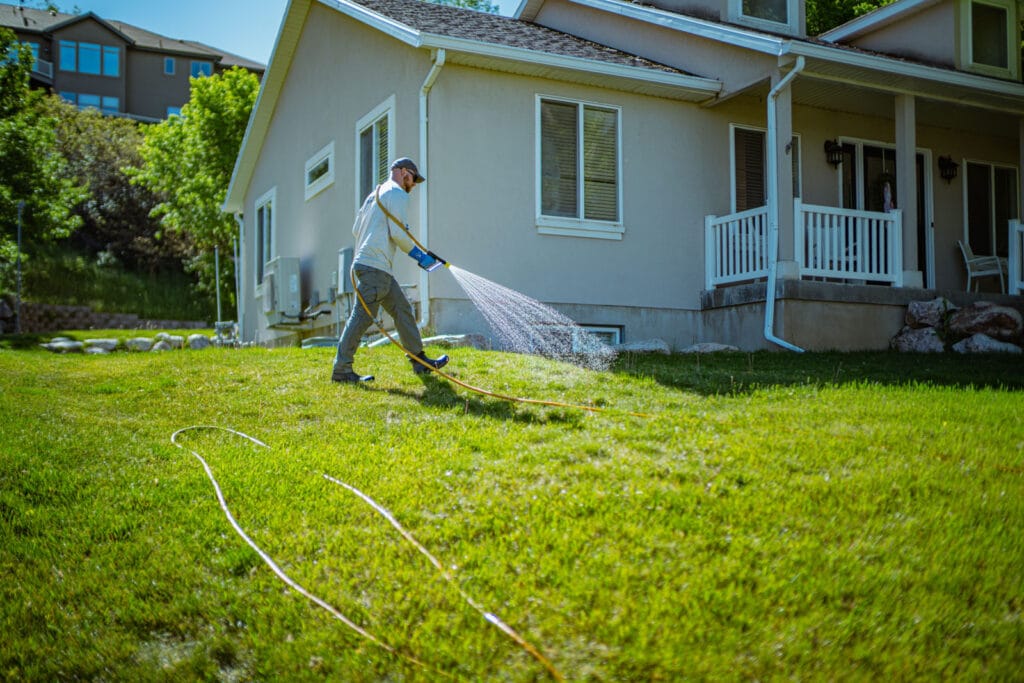
Why Store Weed Killers Disappoint
Homeowners tend to end up with one of two bad outcomes, and they pull in opposite directions.
The first is too weak. Consumer selective products are mixed at lower strength than professional ones, and people often apply too little, spray at the wrong growth stage, or miss spots. The weeds brown, look wounded, and then recover. This is especially true for deep-rooted perennials. Field bindweed, one of the most stubborn weeds in Davis County, stores energy in a root system that runs many feet deep, so a light spray just burns the top and the plant grows right back. We covered bindweed and the other tough perennials in the broadleaf weeds post, and the short version is that they need the herbicide carried down into the roots, which a weak application never achieves.
The second is too strong. Frustrated by weak results, people reach for the strongest thing on the shelf, which is glyphosate, and kill patches of their own lawn. Now they have bare spots. Bare spots are exactly where the next crop of weeds moves in, so the problem comes back worse than it started.
The Right Product at the Wrong Temperature Does More Harm Than Good
This is the part almost no product label puts on the front, and it is where the whole idea of a best weed killer falls apart. The temperature the day you spray matters as much as the product in the bottle.
Kentucky bluegrass is a cool-season grass, and summer heat already stresses it. Add a broadleaf herbicide on a hot day and two things go wrong at once. First, above roughly 85 degrees, these herbicides can damage the grass itself, not just the weeds. Second, 2,4-D and dicamba can turn from liquid into vapor in the heat and drift onto plants you never meant to spray, including tomatoes, flowers, shrubs, and your neighbor’s garden. Trees are vulnerable to that drifting vapor too.
On top of that, the herbicide works worse in the heat. Weeds under heat stress slow down and take up less of it, so you get less kill. A hot-weather application does the worst of both worlds: more damage to the lawn and surrounding plants, and less control of the weeds.
Now put that in a Davis County July. Afternoon highs sit around 89 degrees, triple-digit stretches are normal, and this summer our lawns are already stressed from the drought on top of the heat. That combination makes the middle of summer one of the worst times of the year to spray broadleaf weeds here.
Fall is far better. It is cooler, so the turf-injury and drift risks drop, and perennial weeds are pulling energy down into their roots for winter, which carries the herbicide down with it for a more permanent kill. We explained that fall mechanism in the broadleaf weeds post. The practical takeaway is that the calendar matters as much as the chemical, and the best time to treat most lawn weeds in Utah is not when you happen to notice them in July. Our Full Season Lawn Program is built around that idea, timing weed control to the season and the temperature rather than to whatever weekend is convenient.
Skip the Weed and Feed
Weed and feed products combine a broadleaf herbicide with fertilizer in one bag. One pass over the lawn does two jobs, which is why they sell. The trouble is they compromise both jobs and add a risk most homeowners never consider.
Start with timing. The best time to feed the lawn and the best time to kill weeds rarely line up. The spring weed and feed most people buy hits neither one at its best moment. Then there is the product itself. The herbicide is granular, and granules have to stick to and be absorbed through the weed’s leaves, so on dry grass they roll right off and do nothing.
The bigger problem is that weed and feed spreads herbicide across the entire lawn, including all the areas with no weeds at all. That matters most around trees. The roots of your trees and shrubs reach well past the edge of the branches, running under the lawn, and 2,4-D and dicamba can be taken up by those roots. In a mature Davis County yard, where the trees are often the most valuable thing in the landscape, blanketing the whole lawn with a growth-regulator herbicide every spring is a real hazard to them.
There is also a fertilizer mismatch. Utah soil is alkaline and usually already high in phosphorus, so most lawns here need nitrogen and iron instead. We covered that in the fertilization post. A one-size weed and feed bag cannot match the nutrient blend to Utah conditions, so you compromise the feeding along with the weed control. The better approach is to treat weeds and feed the lawn as two separate jobs, each done at the right time.
What Actually Works
There is no magic bottle. The best weed killer for lawns is the right product, matched to the actual weed, applied at the right time, which in Utah usually means fall, at the right temperature, into a lawn that is already healthy enough to resist weeds on its own. Chemistry is a tool, not a substitute for lawn health. A thick, well-mowed, properly watered lawn crowds weeds out before they start, and that is the real long-term weed control.
When a professional treatment is worth it, the value is not a secret stronger poison. It is four things that are easy to get wrong on your own. The first is diagnosis, because different weeds need different chemistry, and matching the right product to the weed in front of you is a skill built over years, not a guess in the store aisle. The second is timing, treating when the weeds are growing and the weather is right rather than when you have a free afternoon. The third is correct application, the coverage and rates that make a systemic product reach the roots. The fourth is access, since many professional-grade products require a license to buy and apply. In Utah, anyone applying weed control commercially has to be a licensed applicator through the state Department of Agriculture and Food, and that certification exists precisely because doing this correctly is harder than it looks.
If your weeds keep coming back, you are trying to protect valuable trees, or you would rather have the diagnosis and timing handled correctly the first time, that is where we come in. Our weed control service matches the treatment to the weed and the season, and you can see it alongside everything else we do on our lawn care services page.
Can I use Roundup to spot-treat weeds in my lawn?
No. Roundup is glyphosate, a non-selective herbicide that kills any green plant it touches, grass included. Spraying it on a weed in the middle of your lawn leaves a dead weed surrounded by a dead ring of lawn. It belongs on driveway cracks, fence lines, or a lawn you are tearing out entirely.
What is the difference between selective and non-selective weed killer?
A selective weed killer, like the standard 2,4-D, dicamba, and MCPP blend, targets broadleaf weeds such as dandelion and clover while your grass shrugs it off. A non-selective product like glyphosate kills every green plant it touches, with no distinction between weed and lawn.
Is weed and feed bad for my trees?
It can be. Weed and feed spreads herbicide across the entire lawn, including areas with no weeds at all, and tree and shrub roots reach well past the branch line, running under the lawn. 2,4-D and dicamba can be taken up by those roots, which is a real risk in a yard where mature trees are often the most valuable part of the landscape.
Is it safe to spray weed killer on a hot day?
No. Above roughly 85 degrees, broadleaf herbicides can damage the grass itself, not just the weeds, and 2,4-D and dicamba can vaporize and drift onto nearby plants. The herbicide also works worse in heat, since stressed weeds take up less of it, so a hot-day application does more damage and less control than the same spray in cooler fall weather.