
Half the lawn problems homeowners bring up in Davis County trace back to something they never think to check: the soil is too tight for roots, water, or air to move through it. The grass gets enough sunlight. It gets enough water. But the water pools on the surface or runs off onto the sidewalk, the roots stay shallow, and the lawn thins out in the same spots every summer.
That is compaction. And core aeration is the fix.
What Core Aeration Actually Does
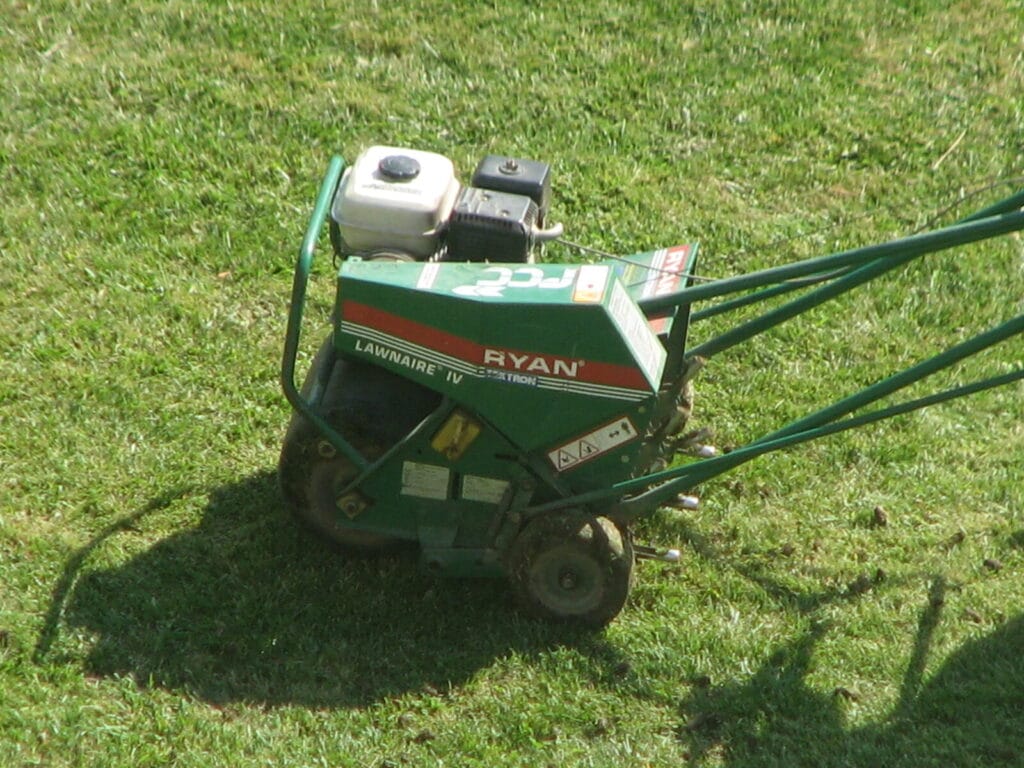
Core aeration is a mechanical process. A machine fitted with rows of hollow metal tines drives across the lawn, punches into the soil, and pulls out small cylindrical plugs of turf and dirt. The plugs are roughly half an inch to three-quarters of an inch wide and two to three inches long. They get deposited on the surface, where they break down in a week or two.
What is left behind are thousands of small open channels running from the surface into the root zone. Those channels do three things that compacted soil cannot do on its own. They let oxygen reach the roots, which need air to function. They let water soak into the soil instead of sitting on top or running off. And they give roots a path of least resistance to grow deeper, which is how grass survives summer heat and drought.
This matters more in Davis County than in most places because of the soil. Clay along the Wasatch Front is alkaline, high in calcium carbonate, and naturally slow to absorb water. Infiltration rates on Davis County clay run as low as a fraction of an inch per hour. Most residential sprinkler systems deliver water at 1 to 2 inches per hour. That mismatch is why water pools on compacted Davis County lawns even when the homeowner is running sprinklers on a reasonable schedule. The soil physically cannot take it in fast enough.
One important distinction: core aeration is not the same as spike aeration. Spike aerators and spike shoes push solid metal rods into the soil without removing anything. On clay, that just compresses the soil sideways around each hole. The compaction gets worse, not better. Core aeration removes soil. That is the difference that matters.
How to Tell If Your Lawn Needs It
Most Davis County lawns need annual core aeration. But if you want to confirm before you schedule, there are a few things to check on a day when the soil is moist but not soggy.
Push a standard screwdriver straight down into the lawn. On healthy, uncompacted soil, a six-inch screwdriver slides to the handle with moderate hand pressure. If it stops at two or three inches or you have to lean your weight on it, compaction is the reason.
Watch your sprinklers run for ten or fifteen minutes. If water is pooling on the surface, streaming across the sidewalk, or collecting in low spots before the soil looks wet at all, infiltration cannot keep up. That is compaction layered on top of the clay’s natural slow drainage.
Cut a small square of turf with a spade and lift it. Healthy Kentucky bluegrass roots in Utah should reach three to four inches into the soil. If the roots stop at an inch or two and spread sideways instead of down, they are hitting a layer they cannot push through.
Look at where the lawn thins out. Under the swing set, along the dog’s path by the fence, next to the driveway where people walk across the grass. If those high-traffic areas are thin while the rest of the lawn looks fine, compaction is the most likely cause.
One more clue: if your home was built after the mid-1990s, the odds are high that the builder scraped the original topsoil, graded and compacted the subsoil for the foundation, and rolled a thin layer of sod on top. That describes most of the newer subdivisions in Layton, Syracuse, Clearfield, West Bountiful, and western Kaysville. Lawns on those lots almost always benefit from aeration.
What Homeowners Can Do
If you have confirmed compaction, there are a few things worth doing before and after aeration that make the results better.
Water the lawn deeply 24 to 48 hours before aeration day. Damp soil pulls clean, full-length plugs. Dry soil produces short, broken plugs that do not open the channels as deeply. Saturated soil clogs the tines. The sweet spot is moist but firm.
Leave the plugs on the surface after aeration. They look messy for a few days, but they break down on their own in a week or two. As they decompose, they return soil and soil microbes to the thatch layer. That microbial activity is actually how aeration helps manage thatch. The plugs seed the thatch with the organisms that break it down.
Do not pair spring aeration with overseeding if you applied a pre-emergent herbicide. The pre-emergent creates a chemical barrier in the top layer of soil. Aeration punches holes through that barrier. Any grass seed you drop lands inside a zone where the herbicide will kill it. If you want to aerate and overseed together, the fall window is the one to use.
For DIY, a walk-behind core aerator rental works. It is genuinely hard physical labor on a quarter-acre lot, and most rental machines require two passes at right angles to hit adequate hole density. Mark every sprinkler head and shallow utility line before you start. A core aerator will not be gentle with anything it rolls over.
How We Handle Aeration in Davis County
We run commercial-grade aerators that pull denser hole patterns than most rental machines can match in two passes. The tine spacing and weight of a professional unit mean deeper, cleaner plugs and more consistent coverage across the lawn.
Timing is based on soil conditions, not the calendar. We schedule spring aeration once the ground has thawed enough for tines to pull full-depth plugs, and fall aeration during the late-summer recovery window when the grass can fill in quickly. The USU Northern Utah Turfgrass Management Calendar identifies both early-to-mid spring and late summer to early fall as appropriate windows for Davis County.
For lawns on builder-graded lots or lawns that have not been aerated in several years, we sometimes recommend two aerations in the first year, spring and fall, to start reversing the accumulated compaction. After that, once a year is typically enough for a residential lawn with normal traffic.
We pair fall aeration with overseeding and fertilization on our Full Season Lawn Program because the three work together. Aeration opens channels for seed-to-soil contact. Fertilizer feeds the new seedlings. The fall temperature window gives everything time to establish before winter. Our core aeration service is also available as a standalone visit for homeowners who want aeration without the full program.